Budget Blues: The United Nations’ Financial Crisis
The United Nations is trending towards ‘imminent financial collapse’ and could run out of money by July, warns Secretary-General António Guterres. Such a dire statement from the head of the world’s largest international organization should sound alarm bells. At the end of 2025, the UN had $1.57 billion USD (£1.36 billion) in unpaid dues from its member states, coupled with financial rules that require the organization to return unspent funds. This has pushed the organization into an unprecedented crisis that imperils its missions worldwide.
One only needs to glance at any UN agency's social media account or page to see references to this budget shortfall: campaigns to convince viewers to advocate for the UN and the resumption of funding to their national governments, pleas for donations from private individuals under the appeal to save ‘one life at a time’, posts from the UN Office for the Coordination of Humanitarian Affairs, which compare the $2.7 trillion USD (£2.04 trillion) spent on defense to the minuscule amount needed to save 87 million lives this year. The UN has reinforced this message through its 87 Million Lives campaign, a hashtag that appears across all its online platforms. Rather than waiting for member states to act, the United Nations has turned directly to the global public to stave off humanitarian collapse. As of March 12, only $9 billion USD (£6.8 billion) of the campaign has been funded.
The UN is funded by its member states through two main avenues: assessed and voluntary contributions, along with small funds for international tribunals and the UN headquarters in New York City. Assessed contributions are divided into two parts. The general budget currently stands at $3.7 billion USD (£2.8 billion), which funds the majority of the UN’s political activities and Secretariat. The peacekeeping budget, calculated separately and currently at $5.4 billion USD (£4.1 billion), funds the UN’s 11 ongoing peacekeeping operations. Voluntary contributions, meanwhile, support the UN’s humanitarian and development activities, including feeding children, responding to disasters, and funding infrastructure projects.
Each UN member state is required to pay its assessed contributions to the organization or lose its General Assembly vote if it fails to make payments for two consecutive years. Member states set the apportionment of contributions through the Committee on Contributions. These levels are calculated based on a nation’s ‘capacity to pay’, calculated on gross national income, debt, and population. The peacekeeping budget functions similarly but also depends on whether a state has forces committed to peacekeeping operations or is a permanent member of the Security Council.
Currently, only 84 member states have paid their contributions to the 2026 general budget. Among the countries who have yet to pay include the United States, which contributes the largest share of the UN’s general budget at 22% and 27% of the peacekeeping budget, though the latter is capped at 25% by Congress. The wealthiest nation’s failure to pay its dues at a time when increased international instability requires more of the UN threatens to destroy this international system, which has been created over the last 80 years.
Beyond member states not paying dues, the structure of the UN financial system threatens to cripple the institution. Under current UN financial regulations, allocated funds not spent by the end of the year must be returned, irrespective of whether the money was received from member states. Guterres said that the UN is currently ‘trapped in a Kafkaesque cycle expected to give back cash that does not exist’, before calling for reform to the organization’s financial rules.
What does this crisis mean in practice? With reductions to the peacekeeping budget, missions that monitor ceasefires, protect civilians, provide policing, and disarm combatants in conflict zones will be less effective. The continued devastation inflicted by landmines from past conflicts will go uncleared.
If the general budget faces shortfalls, the UN’s administrative functions will suffer, with departments already planning massive staffing cuts. This means fewer experts in highly technical fields to coordinate international actions, fewer investigators for human rights’ abuses and war crimes, and less cooperation to ensure the peaceful and safe use of outer space, facilitate disarmament, respond to natural disasters, and combat transnational drug crime. Without voluntary contributions, the World Food Programme won’t purchase and distribute food for US farmers, further exacerbating hunger and famine. The High Commissioner for Refugees and UNICEF, the UN Children’s Fund, can’t support refugees and children fleeing conflict. Even organizations of the UN System with their own funding sources are not immune. The US has already withdrawn from the World Health Organization, taking with it funding for disease research and responding to future pandemics. The International Atomic Energy Agency will have less money for inspectors, imperiling the safety of civilian nuclear facilities and weakening the non-proliferation of nuclear weapons.
As the United Nations turns 80, where does it go from here to prevent collapse? The easiest solution would be for all nations to resume funding, paying their full dues on time and in full. However, this is unlikely to occur and fails to address the underlying problem behind this financial instability. To ensure its long-term stability, the UN requires reform, something Secretary-General Guterres has long advocated for and pursued. Deep structural reform of the UN requires the support of its member states, an idea many nations have called for but lack the political will to enact. The UN is urgently pursuing internal reforms, such as transferring staff from high to low-cost cities and combining duplicate mandates. This year, the world will choose a new Secretary-General to lead the UN. They will take the helm of an organization, arguably in its darkest hour, and lead it into an uncertain future. In the best-case scenario, the UN will need to do more with less. But more likely, the UN instead will be doing less with less.
In a time when many nations face domestic budget constraints, politicians have called for cuts in international spending, supposedly in favor of supporting their own citizens. Politicians advocate for slashing UN, foreign, and humanitarian aid for short-term gain, endangering their citizens’ long-term security. It is simple: defund the UN, and people die. When the US shut down the Agency for International Development, it is estimated that hundreds of thousands of people died from infectious disease and malnutrition. The collapse of the UN would be much worse. This will destabilize an already tumultuous world, one that will be less able to respond to refugee crises, environmental disasters, disease outbreaks, and conflict.
The world risks returning to isolationism, where the richest nations retreat behind their borders while the rest of the world burns. But crises will reach even the wealthiest nations, and there will no longer be a UN to help or coordinate the international community. The United Nations is not a perfect institution; it desperately needs reform that requires action from all its member states, but a world without the UN is more dangerous for everyone. After all, in the words of former Secretary-General Dag Hammarskjöld, ‘it has been said that the United Nations was not created in order to bring us to heaven, but in order to save us from hell’.
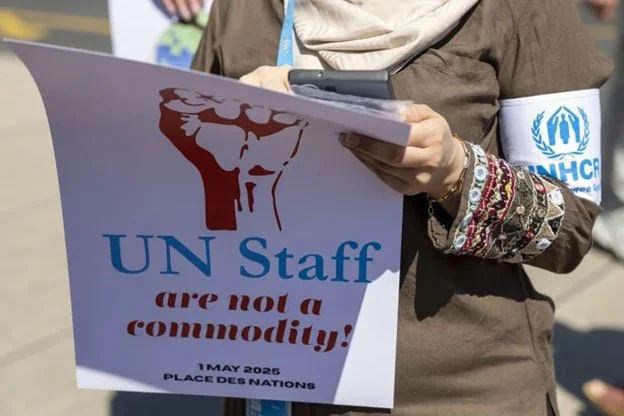
Image courtesy of Salvatore Di Nolfi via Keystone, ©2025. Some rights reserved.
The views and opinions expressed in this article are those of the author and do not necessarily reflect those of the wider St Andrews Foreign Affairs Review team.