How Mamdani Interrupted a Cycle of Corruption in New York City
Just nine months before the New York mayoral election, Zohran Mamdani was polling at 1% name recognition. More frightening, however, was his position: he directly challenged not only ‘behemoth’ former Mayor Andrew Cuomo and posited himself against the real estate and transportation lobby with his promises to freeze rent and make public transportation free.
And yet, after New York’s largest voter turnout in 30 years, Mamdani won the mayoral election, following a surprise primary win, in “the biggest upset in modern NYC history.” His win, by a margin of nearly a million votes, totalled almost as many as had even shown up for the last mayoral election.
What made Mamdani’s campaign so successful? What about him made dispassionate New Yorkers emerge in droves to vote democrat amidst historic lows in popularity for the party?
Certainly, his success cannot be attributed to support from the democratic party. Throughout his campaign, in addition to racist caricatures from republican opposition, he was also on the receiving end of an almost slanderous campaign from the New York Times. The newspaper, after vowing not to endorse in local races, published an op-ed praising Cuomo despite his resignation from the governor’s office in disgrace four years ago after a barrage of sexual misconduct allegations. Even after the primary, the Times doubled down, attempting to engineer controversy with an article of dubious news value questioning Mamdani’s identification as Indian and Ugandan on his college applications titled ‘Mamdani Identified as Asian and African American on College Application.’
Mamdani also did not receive unified support from his own party. Former mayors Eric Adams and Michael Bloomberg endorsed Cuomo, among other prominent democratic leaders: New York rep. Richie Torres, Sen. Jessica Ramos, Former President Bill Clinton, and House Minority Leader Hakeem Jeffries, though he later changed his mind. Some of these endorsements came from those who four years ago called for Cuomo to resign on the grounds of the credible flood of allegations of sexual predation against him.
What, then, if not favourable press or partisan loyalty, is behind the meteoric success of Mamdani’s campaign?
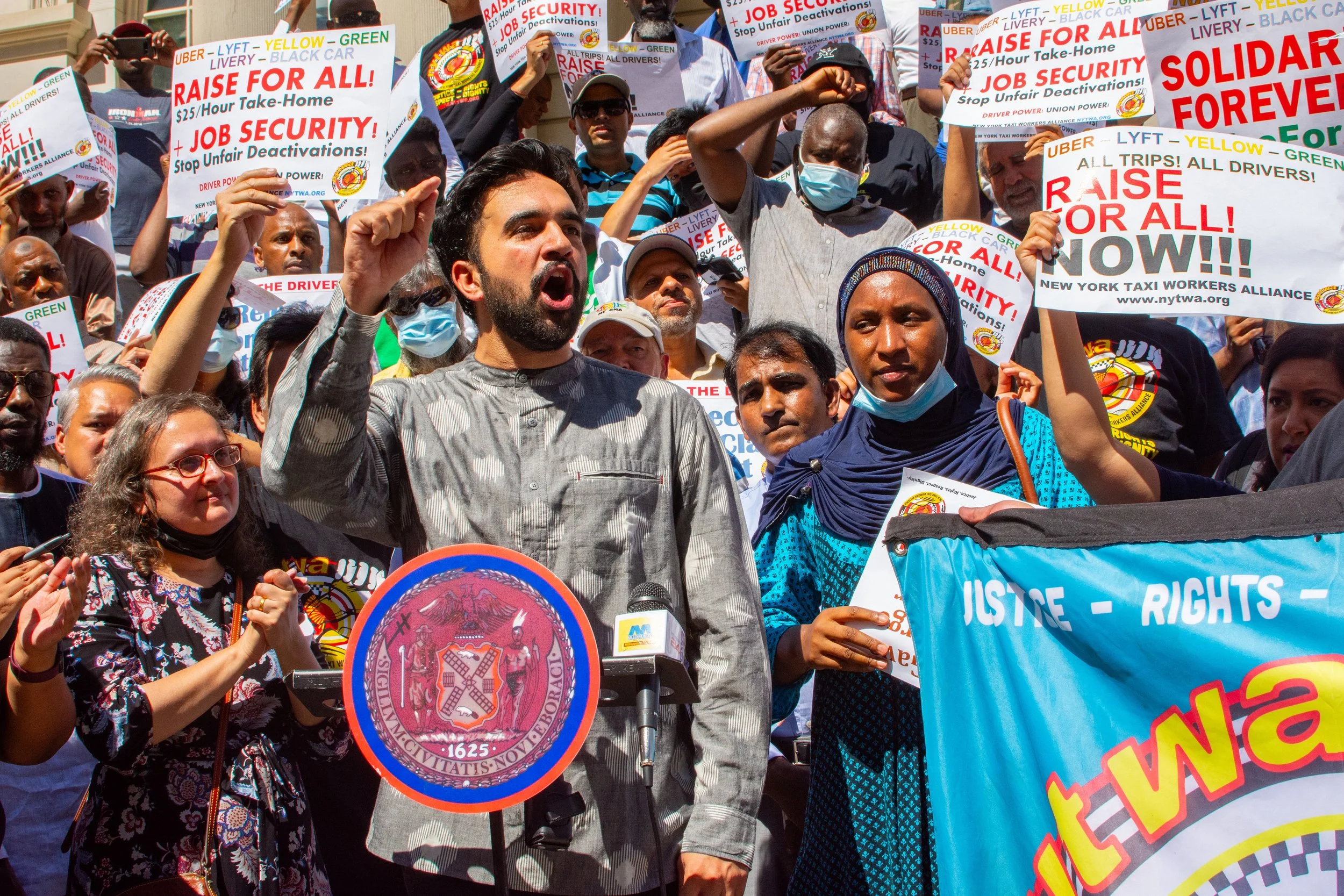
One aspect that remains surprising about the campaign is its focus on physical campaigning. Mamdani’s canvassing force numbered over 100,000, in the greatest field operation in the history of New York. The bulk of this canvassing was done by volunteers, who quickly overwhelmed the campaigns initially modest estimates – a target set for training 250 field leads became over 500 in a manner of weeks. Volunteers
showed up in groups of 50 or 100 for one single field lead. Even more unprecedented was the authority transferred to these volunteers, regardless of their history with canvassing: they were given no script or time limit, and instructed to simply engage with people, and ‘not to chastise not to speak down to people who turned to Trump or who just didn’t vote,’ according to Álvaro López, electoral coordinator of New York’s chapter of Democratic Socialists for America (DSA). These tactics might account for Mamdani’s gains in areas like the Bronx, a majority Hispanic borough who swung soundly towards Trump in the last presidential election.
In June, Mamdani filmed himself walking the length of Manhattan – thirteen miles – in an example of the kind of in-person campaigning most candidates across both parties have either abandoned or are usually far too old for. His online profile is largely comprised of stunts like these, emphasising his physical engagement with the city even in the digital sphere. Andrew Epstein, the campaigns creative director, explains how this was intentional and integral to the campaign: Mamdani’s videos were made with the motive of “embedding Zohran in the kind of street-level life of New York City, putting him all over the city, interacting with people over the city in a million different contexts.” In another video posted on Tik Tok, Mamdani, fully clothed in a suit, plunges into Coney Island’s freezing beach. But for most of the video, Mamdani simply speaks to the camera, pledging to freeze rents on behalf of the 2 million New Yorkers, replace the acting members of the Rent Guidelines board. There are no attention-grabbing gimmicks in the video - save Mamdani’s brief plunge – no AI, no music, and a run time longer than most campaign ads, at fifty-nine seconds. Instead, Mamdani simply speaks to the camera as he walks, in an almost endearingly outdated use of social media. The Atlantic calls this ‘the opposition of slop politics.’
The earnestness of Mamdani’s digital campaign disrupts the spew of vitriolic ‘slop’ that has come to define digital politics. Though usually associated with MAGA, there are some democrats, like Gavin Newsom, who have adopted these tactics: in one tweet he replies to a video of the Oval Office with an AI- generated image of President Trump as Marie Antoinette, captioned ‘NO HEALTH CARE FOR THE STUPID PEASANTS, BUT LOOK AT THE QUEENS GOLDEN OFFICE!! (GOLDEN BIDET NOT PICTURED.)’ While content like this draws engagement, they are, as Charlie Warzel of The Atlantic points out, ‘not a policy response’ or an attempt to educate, but rather ‘just a middle finger, dressed up as content, optimized for maximum engagement’ from already entrenched supporters and rage from everyone else. The use of AI by Newsom, governor of a state gripped by an ongoing water crisis exacerbated by climate change, casts a darkly absurdist tone to his words.
Despite vast amounts memes, fancams, and movements like ‘Hot Boys for Zohran,’ swirling around Mamdani throughout his campaign, his own content has always been defined by the genuine straightforwardness present in his Polar Plunge video. This becomes his strength: he never trivializes what he stands for, approaching social media with a seriousness but ‘lets the fun swirl around him.’
Mamdani’s success, hinging on his inversion of political norms on every level, comes at a moment in which politics is increasingly defined by a competition of whose inflammatory AI slop dominates more seconds of attention. His victory shows us that there is a craving for virtue, truth, and human connection in politics. Hopefully his campaign will serve as a blueprint for those who want to make change.
Image courtesy of ImaginedImages via Wikimedia, ©2024. Some rights reserved
The views and opinions expressed in this article are those of the author and do not necessarily reflect those of the wider St Andrews Foreign Affairs Review team.