What Timor-Leste’s Ascension Means for ASEAN Amid Rising Foreign Influence in the Region
Asia's youngest nation-state, Timor-Leste's ascension to ASEAN, marks the bloc's first expansion in the 21st century, following an ascendency process which began over a decade ago, culminating in tears of joy from the Timorese delegation.
As Timor-Leste finally enters its political home, the addition of an eleventh member to ASEAN highlights the importance of maintaining the association's identity as a bloc defined by inclusion rather than division. The introduction of Timor Leste has provided a democratic success story, with one of its own now backsliding, while anchoring its eastern flank within its consensus-driven framework.
In a geopolitical context shaped by Washington and Beijing, it became clear that Timor-Leste's integration offered an opportunity to shape Southeast Asian foreign affairs from within. Only through full integration can Timor-Leste mark this victory for ASEAN. Despite the economic challenges of integration, the potential is undeniable, with a young population seeking regional mobility and untapped maritime routes, and a government prioritising regional economic involvement alongside diversifying the economy away from petroleum. ASEAN has integrated developing states before, as seen in the cases of the Indochinese states; however, the lessons learnt from these processes remain relevant.
Ensuring Timor-Leste can maintain its obligations to ASEAN and its sovereignty from the aforementioned superpowers remains key to ASEAN's success.
Timor-Leste enters ASEAN at a time when the region's strategic value is at a modern high, as interactions between East Asian states and the major powers have morphed beyond bilateral relations towards a genuine question of sovereignty. Timor-Leste's addition to ASEAN presents an opportunity to change the too-often reactive nature of ASEAN when it comes to ensuring the sovereignty of its members. The Ombai–Wetar Strait off the northern coast of Timor, serving as a key route for shipping to Japan and Australia, is key towards ensuring regional security and sovereignty within the region. Currently, the competitive space through which foreign states can utilise economic strength to promote their interests, as seen with Australia's previous spying and China's focus on maintaining control over its second island chain.
Timor Leste's entrance into ASEAN places the region within the oversight of ASEAN's consensus-driven model, allowing the bloc to support Timor Leste in navigating its position while protecting its sovereignty. Through ensuring that decisions which impact Timor-Leste are discussed at the ASEAN table, Timor-Leste can lean into the collective strength of the bloc to ensure foreign powers do not exploit their power asymmetry in negotiations. Through negotiating alongside Timor-Leste, ASEAN is able to ensure that Timor-Leste does not become a conduit for external influence.
Timor-Leste should join not solely as a beneficiary of ASEAN but as a contributor towards regional security. The future interactions between Timor-Leste and foreign powers, accompanied by ASEAN's involvement, will set the tone for the future of Southeast Asian sovereignty.
The most immediate challenge facing Timor-Leste remains transforming political inclusion into economic opportunity. The primary motivation for Timor-Leste's interest was and remains economic, especially considering the state's reliance on petroleum. Through linking the country to trade pathways, especially regarding labour mobility, Timor Leste's youth stand to benefit from stronger labour flows and educational access across the bloc. As connectivity improves, the potential for growth in sectors such as fisheries, tourism and light industry becomes far more possible now Timor-Leste is not operating in isolation. This potential however will only be realised through investment into infrastructure through the bloc, rather than foreign powers, due to previously mentioned concerns over sovereignty.
China has already begun investment through their construction of the Tibar bay port near Dili; however, the port serves to support trade rather than national infrastructure development. Timor-Leste's development could mirror the development seen in Vietnam through ASEAN investment, however, on a much smaller scale. Vietnam's success did not come through foreign patrons uninterested in domestic development; it was achieved through regional integration and alignment with ASEAN's economic framework which allowed foreign direct investment to occur whilst maintaining sovereignty. For Timor-Leste, such support is not merely desirable but essential. Without it, infrastructure may expand, but sovereignty will contract, as key national assets become tied to the strategic ambitions of external actors. Actions such as the ‘Initiative for ASEAN Integration’ have previously aided in reducing disparities between members.
Timor-Leste would require immediate and targeted investment in order to mirror Vietnam's growth, rather than follow in Myanmar's footsteps of democratic and economic backsliding. The bloc stands to gain from this as much as Timor-Leste does. Improved connectivity across the eastern archipelago strengthens regional supply chains, while a more dynamic Timor-Leste labour force reduces the risk of national labour market pressures boiling over into instability.
Timor-Leste's accession presents ASEAN with a real test of its capabilities. Welcoming a new member is the easy part. If ASEAN can successfully support Timor-Leste's integration, it proves that the bloc is capable of shaping regional development and defending the sovereignty of its smaller members, presenting an alternative approach towards maintaining sovereignty within a contested region. However, if support fails to adequately address the demands of Timor-Leste, both ASEAN and Timor-Leste itself will be undermined.
Timor-Leste's success will reflect the strength of ASEAN itself. A region that has too often been defined by external rivalry now has the opportunity to define itself through internal solidarity. The path forward may be demanding, but it is also clear that ASEAN's credibility will be measured not by how quickly Timor-Leste joined, but by what that membership delivers for the future of Southeast Asia.
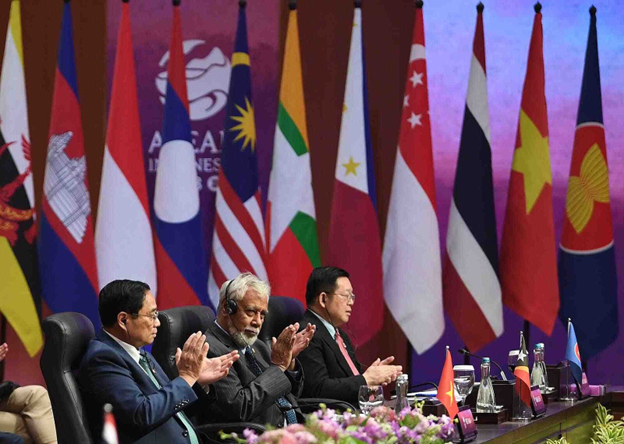
Image courtesy of Media Center of The ASEAN Summit 2023 via Wikimedia Commons, © 2023. Some rights reserved.
The views and opinions expressed in this article are those of the author and do not necessarily reflect those of the wider St Andrews Foreign Affairs Review team.