Nvidia: The Power of the Individual, Corporation, and State
At the end of October, Nvidia reached unprecedented heights, being the first company to mark $5 trillion (£3.8 trillion) market capitalization. This amount is more than most countries’ GDP. Nvidia’s stock (NVDA) has even risen 5% in the US. stock market. CEO, Jensen Huang, has pushed an agenda to lead the global tech industry including the competition in artificial intelligence (AI) despite theories about an AI bubble, a rapid AI boom effecting the larger economy with fears of ‘a bubble burst’. As a leader in one of the most profitable industries in a world where technology dominates the market, Huang has been gaining more political influence.
For more than 30 years, Nvidia has incorporated their accelerated computing into various industries. Huang says they ‘continue to drive advances in AI, [high-performance computing] HPC, gaming, creative design, autonomous vehicles, and robotics.’ As an innovative figure in the new age of technology, Nvidia finds themselves with ability to negotiate in the political arena, reflecting an order where corporations have power. This is different from traditional state-authority where even businesses can create deals with leaders, as Nvidia has done in the past with China.
Friction in Bilateral Politics
Nvidia’s financial clout translates directly into their influence to direct technological change. This includes a multitude of projects in AI chips, digital economics, cloud infrastructures, and military modernization. Currently Nvidia’s Blackwell architecture (B200, B30A) and previous high-end models like the H100 and H200 is one of the most advanced chips in the world. As such, they are able to gatekeep technological advancement for countries pursuing in AI and its applications. China’s pursuit of AI innovation, with Nvidia’s help, is dual-edged – it gives them both technological and economic capital alongside the ability to garner more political power through economic and political influence. With the given competitive relationship between the US and China, President Trump wishes to curb Chinese advancements in AI including the acquisition of advanced chips, fearing military applications and consequences to American tech superiority.
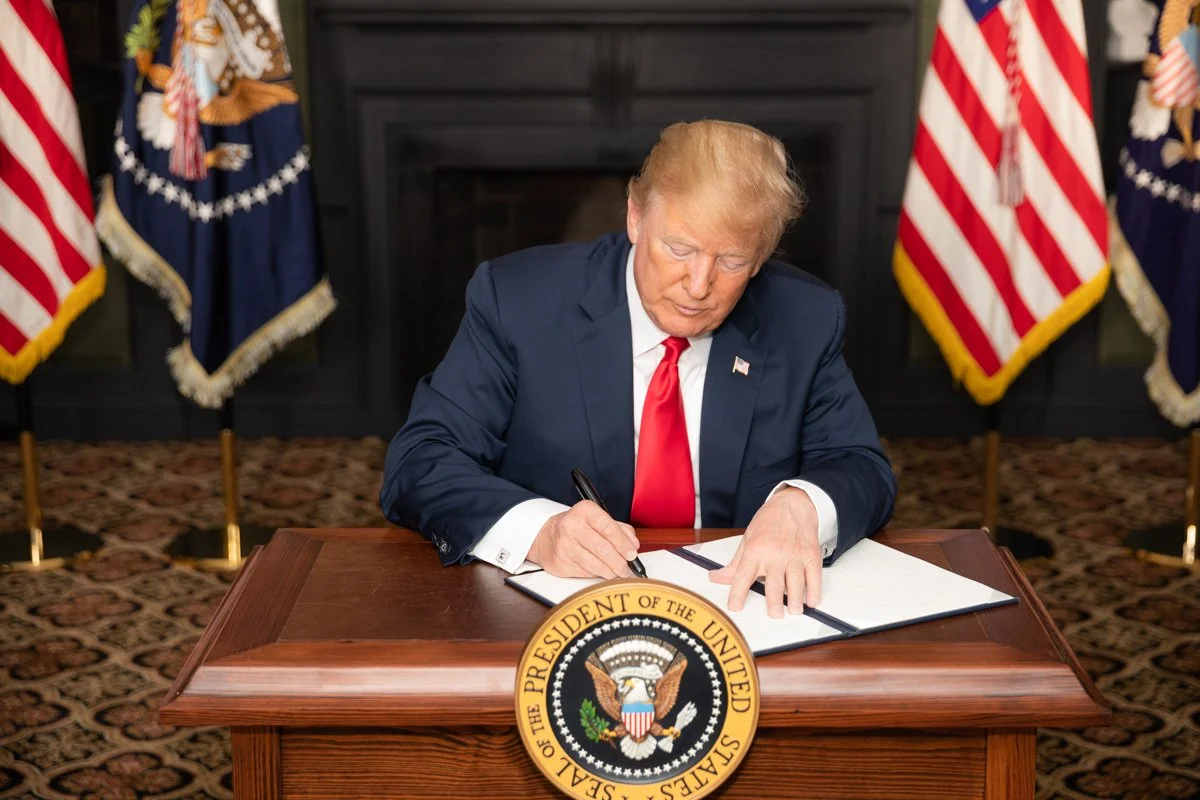
During the CEO summit of Asia Pacific Economic Cooperation (APEC) in Gyeongju, South Korea, Huang shared that ‘we used to have 95% share of the AI business in China. Now we're at 0% share.’ In 2024, Chinese purchases made up more than a tenth of Nvidia’s revenue alone but Trump’s trade war with China’s president, Xi Jinping, has disrupted this partnership. Since the start of Trump’s trade restrictions, US export controls have blocked Nvidia’s chips directed to China and Chinese entities. Instead, China have been directed to favour domestic alternatives for state-funded projects like Huawei and Alibaba. To enforce their control on supply chains, Beijing even announced that any company would need approval to export goods containing even trace amounts of its rare-earth metals. On 30th October, Trump met with Xi in South Korea to discuss tensions caused by the current trade war which started last year. Regarding Trump’s stance on AI chips, his reported stance led ‘that’s really between you [China] and Nvidia, but we’re sort of the arbitrator,’ indicating that Nvidia is a political player but subject to the US government state authority.
Political Agency beyond China
Still restricted from accessing the markets in China, Nvidia has found different avenues to increase their growth. South Korea’s political-economic agenda has joined the trend in AI investment, wanting to be an international hub. Nvidia has agreed to supply the Korean government with over 26,000 advanced chips where more than 50,00 will power data centres at the National AI Computing Centre owned by South Korean companies like Kakao and Naver. The American tech company has also partnered with companies including Samsung, LG, and Hyundai, their chips supporting semiconductors, robots, and autonomous vehicles.
Similar logic has been applied to industry at home in the US. Huang announced, at his first-ever keynote speech at the company’s GTC AI conference, his plans to strengthen Nvidia’s business not just in AI, but other areas of technology from cell phones to cars. Since then, he plans to release a blueprint for AI factories (extremely large-scale AI data centres), a model which other firms can potentially replicate. As a growing political figure, Huang has had further contact with Trump outside the meeting with Xi: ‘the first thing that President Trump asked me for is [to] bring manufacturing back, bring manufacturing back because it’s necessary for national security,’ Huang said. Nvidia has also partners with US firms like T-Mobile and Nokia to build ‘AI-native’ 6G cell phone towers, the next generation of wireless technology, so they can spearhead the AI industrial revolution from within the US. With the US Department of Energy, Nvidia plans to build seven new quantum supercomputers with its AI chips to advance the agency’s scientific research. At the same time, Nvidia and Siemens is releasing technology to make ‘digital twins’ of robotic factories. Nvidia’s portfolio of partnerships indicates their approach to assimilate their technology across all emerging markets. Their role in the political economy cannot be denied.
AI Bubble Risks
The above narrative highlights Nvidia’s political agency. But criticism asks if AI investment has become too large. Will the AI frenzy prove to lead history down the same path as the Dot Com bubble burst in 2001? Will its dependency lead to another recession? In a recent report from Massachusetts Institute of Technology (MIT), 95 percent of companies investing in generative AI are seeing 'zero return'. These results raise fears and questions on market evaluations, especially after Japanese billionaire and SoftBank founder, Masayoshi Son, sold off all of his Nvidia and T-Mobile stocks, in preparation of collapse, for roughly $15 billion (£11.42 billion). International leaders including Trump, Xi, and the UK’s King Charles have recognized the extraordinary potential AI has to transform society but has the power to be evil and to cause recession, pushing discussion toward ethical use, and long-term economic impact.
Conclusion: The Power Nexus
Nvidia’s financial expansion and partnerships is controlling the technological landscape to come. Now integrated into the very infrastructure in which states rely, Nvidia’s power has become a force to be reckoned with, an actor who sets its own agenda. At its core, Nvidia is a commercial enterprise but is acting as a quasi-sovereign agent, regulating industry, setting precedents, and negotiating in political controversies. Huang and other leaders plan for AI and supercomputing to stay. As innovators for the future, they control the next generation of economic competition, international security, and governance in technology.
Image courtesy of Mariia Shalabaieva via Unsplash, ©2024. Some rights reserved.
The views and opinions expressed in this article are those of the author and do not necessarily reflect those of the wider St Andrews Foreign Affairs Review team.