Do U.S Headlines Conceal the True Policy Intentions with Venezuela?
News coverage of military airstrikes on boats suspected of narco-terrorism has taken over headlines in recent weeks. The blame has been directed towards Venezuelan president, Nicolás Maduro, characterizing him as the main contributor to the opioid and fentanyl crisis in the U.S and as a source of the illegal immigration problem, leading to conversations around a possible regime change. When looking at the drug problem in the United States, Venezuela is not the main enemy, yet there have been no direct military campaigns against both Mexico and China, main contributors to the crisis. With factors such as energy security, democracy, and international criminal sanctuary all being rational concerns for U.S-Venezuelan relations, why is the White House using the drug problem to justify potential regime change in Venezuela?
In recent weeks, the Trump administration has carried out a number of military campaigns in international waters, consisting of airstrikes on boats off the Caribbean which US officials alleged were trafficking drugs from Venezuela. This, along with the deployment of 10,000 U.S. troops to the region has been vocalized by Trump as a move to combat narco-terrorism by the Venezuelan government. Extrajudicial killings in international waters by the U.S military violates international human rights law, and 60 people have reportedly been killed. Venezuela reacted to this instigation with a massive mobilization of troops in response to an encroaching ‘imperial threat’ by the U.S.
Blaming Maduro for the American opioid crisis comes as a surprise, given that almost all fentanyl in the United States is smuggled across the border with Mexico, and that China is the leading manufacturer of fentanyl's components. Trump has also raised another potentially false flag against Venezuela as he claimed Maduro released people from ‘insane asylums’ into the U.S, causing several immigration and criminal disruptions. Is it simple confusion from Trump in differentiating between an insane asylum and people seeking asylum, or is he leveraging the fears of some Americans to garner support for his foreign policy?
In the era of Trump, it is difficult to parse through the rational and irrational behavior, especially concerning foreign policy. U.S-Venezuelan relations include many problematic factors, including the issue of democracy and national and energy security that could all be contributing to the desire for regime change in Venezuela. These very real security issues present legitimate implications for the U.S and Venezuelan citizens and could be the root of growing tensions in the region.
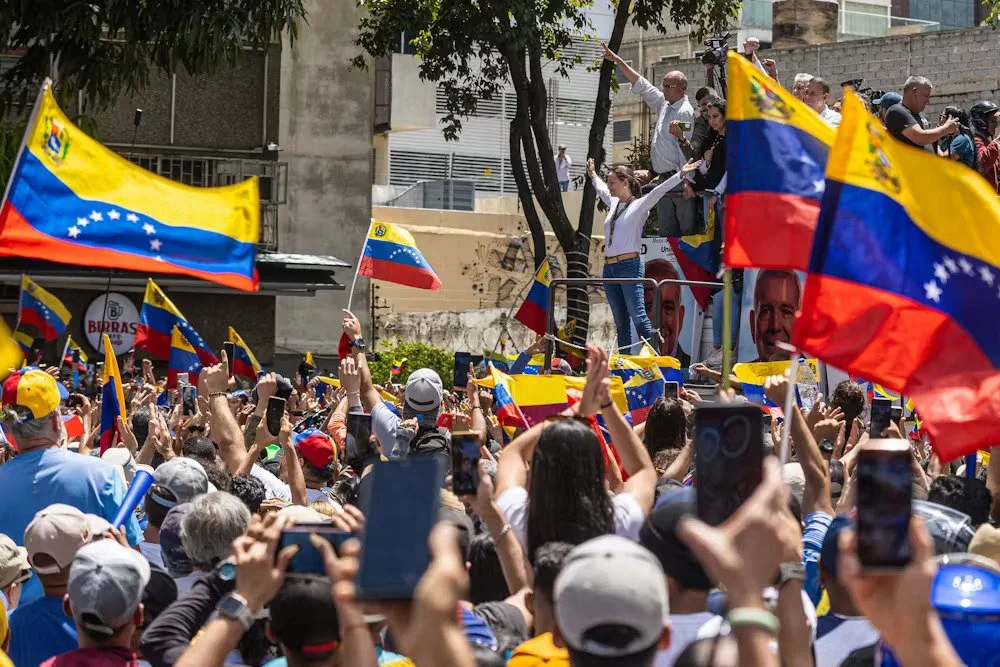
It is impossible to talk about Venezuela and not mention the human rights abuses carried out by the current dictatorship. Under Maduro’s regime, Venezuela reached poverty rates as high as 73.2% in 2024. Venezuelan citizens face food insecurity and unpredictable access to potable water, resulting in 7.9 million refugees and migrants globally. 25 years of socialism and repression by Maduro’s government has created an economic freefall in the Latin American country, adding to the number of reasons that Washington is in support of regime change. The White House sees the lack of democracy in Venezuela as concerning for themselves and for Venezuelans. The 2024 elections saw the victory of the opposition party by a landslide, with González Urrutia winning the vote after the previous opposition candidate, Nobel Peace Prize winner Maria Corina Machado, was banned from running. Machado’s ultimate absence from the ballots after her outspoken opposition to the regime forced her into hiding for 15 months, revealing the deeply rooted corruption of the government. Maduro has remained in power despite his loss in the past election, creating a mockery of free elections in the country. Machado has vocalized her encouragement of U.S intervention in Venezuela, as she says this would not be a traditional regime change, but rather an “enforcing of the will of the Venezuelan people.”
Other rational factors for the U.S intervention in Venezuela includes national security risks. In various interviews, Machado has revealed that individuals from Hamas and Hezbollah, terrorist groups in Palestine and Lebanon respectively, are finding sanctuary in Venezuela. Additionally, Iranian and Russian agents are reportedly operating out of the Latin American country. The presence of international enemies of the United States working in close proximity to the U.S. poses serious risks. The potential of these militants having control or access to the largely underproduced oil markets in Venezuela is another area of concern for the United States.
Negotiation talks in early 2025 between U.S officials and Maduro over the expansion of the oil industry appear to have morphed into a campaign to overthrow the Venezuelan dictator. Military operations against alleged drug boats from Venezuela posed minimal risks of a supply shock in the world energy market considering Venezuela’s contributions to the global oil supply falls around 0.9%. Historically, almost all U.S global military intervention has been in response to economic concerns they could potentially face. In this case, Washington foresees significant benefits from a pro-Western and pro-business government in Venezuela. Venezuela’s current meager oil production is a result of politics rather than commerce that has inhibited them from becoming an oil giant. An energy power in the Western hemisphere who is sympathetic to the U.S would reduce Western reliance on energy from the Middle East and Russia and bolster Venezuela’s economy. A government that could responsibly navigate the oil industry’s growth in Venezuela could position the country for economic rebound after decades of downfall.
Despite what the U.S might gain from regime change in Venezuela, historic CIA operations in Latin America have been discouraging. In the cases of Ecuador (1963), Brazil (1964), Chile (1964), Bolivia (1964), and Panama (1981), U.S intervention has resulted in a decline in real income per-capita, democracy scores, rule of law, freedom of speech, and civil liberties. With a goal of democracy, it is impossible to ignore the reality of the outcome of regime changes carried out by the U.S in Latin America and the costs to citizens. In these cases, data reflects that CIA backed regimes, in the long run, further crushed democracy with a negative long-term effect. While dynamics in Venezuela today differ from the examples above, it would be naïve to assume a regime change enacted by the US would be a complete success story.
It is clear that U.S engagement with Venezuela extends far beyond the narco-terrorism and immigration headlines that plague the news. In an era of unpredictable foreign policy decisions, ranging from extreme tariffs on allies and aggressive military behavior, current headlines cannot be taken as indicative of the actual U.S goals. Given the unclear intentions from the White House, it would be a mistake to reject the assumption that more significant policy maneuverings are at play under the current administration.
Image courtesy of Henry Chirinos via EPA, ©2024. Some rights reserved.
The views and opinions expressed in this article are those of the author and do not necessarily reflect those of the wider St Andrews Foreign Affairs Review team.