The Washington Post: All Washed Up?
In early February, the Washington Post made significant cuts to its workforce. Among those affected were reporters covering the Middle East, sports and the Russia-Ukraine war from Kyiv. Just days later, CEO Will Lewis announced his decision to resign.
The move, which was announced over email to approximately 300 staff members across the newsroom who were laid off, is not the first change made to the Washington Post that has drawn significant ire from the public eye. In the run-up to the 2024 US presidential elections, the paper had initially planned to endorse former Vice President Harris in her electoral campaign. However, Bezos, the current owner of the paper, personally intervened to prevent the Washington Post from endorsing a presidential candidate, the first time it had failed to do so since the 1970s. The paper further announced it would permanently end the practice of endorsing a presidential candidate for any future US presidential elections.
The move was deeply lambasted as a displeasing break from a long tradition at the Washington Post. It was also seen as highly alarming since it appeared to threaten the relative journalistic independence Bezos had promised to provide the paper once he acquired ownership.
This begs the question of when exactly a shift towards a fundamental reshaping of the Washington Post took place. In 2013, Jeff Bezos, founder and CEO of Amazon bought the Washington Post for $250 million from the Graham family, the longtime owners of the paper, who had been struggling to make the paper profitable in the face of decreasing revenue from advertisements, declining subscribers and a media landscape increasingly dominated by the Internet.
Reports almost unanimously suggest the initial stages of Bezos’ tenure as owner of the Washington Post began in a promising manner, even promising a ‘new golden era’ for the paper. Bezos appeared to promise his primary goal for the Washington Post was not to ensure it was profitable, since he had highly profitable ventures otherwise, but rather, act as a guardian for the paper amidst its financial struggles. This began well, with Bezos pumping money into the paper, and publicly promoting journalism. Soon after Bezos’ takeover of the company, the Washington Post adopted the slogan ‘Democracy Dies in Darkness’ in 2017, which was justified by Bezos himself as a recognition of the importance that institutions play in the safeguarding of democracy and the importance quality journalism plays in the contemporary world.
During Trump’s first term as US President, Amazon lost out on a contract with the American government for the Joint Enterprise Defense Infrastructure (JEDI) program, which Amazon claimed in a lawsuit was directly due to pressure from Trump. It is plausible that Trump’s distaste of the Washington Post, which, backed by Bezos, was often in direct opposition to Trump, may have played a role in negatively affecting Trump’s perception of Amazon, and resulted in the drying up of business prospects with the American government.
Since the lead-up to Trump’s second term, Bezos has been accused of trying to mend his relationship with Trump precisely because of the threat Bezos’ ownership of the Washington Post posed to the business interests of Amazon. Soon after pulling an endorsement of Harris in the 2024 US presidential elections, reports suggested 250,000 people - 10% of Washington Post subscribers - had sent out emails to cancel their subscriptions to the paper, reflecting a strong public reaction. The further choice to focus the opinion section of the paper on the defense of personal liberties and free markets prompted the opinions editor at the time to resign.
The axing of numerous positions at the Washington Post just last month was described as akin to ‘witnessing a murder.’ While February may have marked an exceptionally dark day in the paper’s history - the beginning of the end, as it were - it may also be possible that the Washington Post has been facing a series of painful challenges to its very identity for a long time, and that this latest development is one of the many worrying developments the paper has recently faced.
The legacy, and hard-hitting impact of the Washington Post is undeniable. However, the recent developments at the paper beg the question of whether the Washington Post will survive its latest ordeal.
In other words, is the Washington Post all washed up?
In a climate where journalistic integrity and freedom of the press is under unprecedented attack, the Washington Post has not emerged unscathed. Answering whether there is any hope for its future ultimately, appears to depend on Bezos himself. If Bezos were to once more hopefully recognise the value that the Washington Post has reliably provided to the American public by holding government and other actors accountable - and the international community - and the importance of a press unimpeded in its efforts to provide information and awareness to people, and the strength this can provide to American democracy, perhaps there is hope for the Washington Post after all.
As of the present, if democracy does indeed die in darkness, as the paper’s motto has phrased it for almost a decade, current events at the Washington Post suggest Bezos may have already snuffed out the lights.
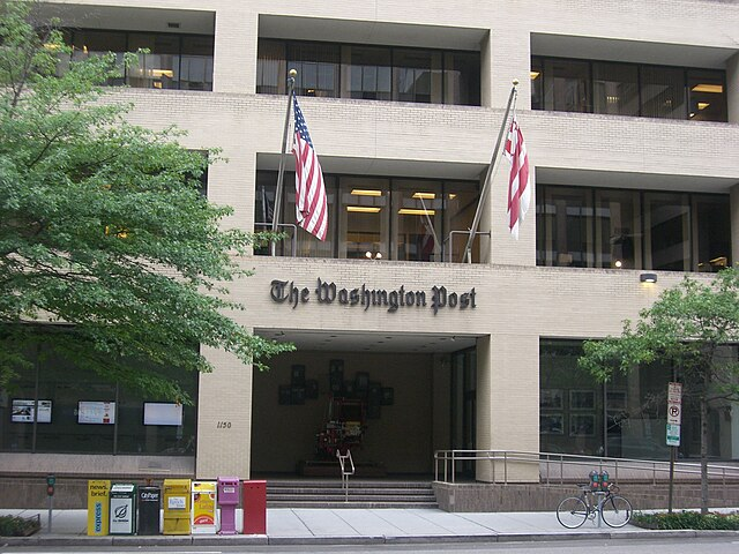
Image courtesy of Michael Fleischhacker via Wikimedia Commons. Public Domain.
The views and opinions expressed in this article are those of the author and do not necessarily reflect those of the wider St Andrews Foreign Affairs Review team.