America’s ICE Expansion: Authoritarianism or Enforcement?
With an incredible spike in media attention since the beginning of President Donald Trump’s second term, a dramatic rise in interior arrests and deportations, and two recent, highly politicised killings on American soil, who are ICE, what are they really doing, and what has actually changed? Despite its current notoriety, the U.S. Immigration and Customs Enforcement (ICE) is no new invention of the current administration. The agency was established in 2002 as part of the Department of Homeland Security (DHS) in response to the 9/11 attacks. So why does today’s enforcement regime appear to be shaking up the status quo so emphatically?
Since renewing his presidency in 2024, Donald Trump has positioned ICE as the central infrastructure of his mass deportation initiative. Determined to deliver one of the defining promises of his re-election campaign, he has significantly expanded the agency’s budget, capacity, and operational mission. The clearest example came in July 2025 with the passing of a major federal law, modestly nicknamed the “One Big Beautiful Bill.” The legislation allocated approximately $170 billion for immigration and border enforcement services, with an estimated $75 billion directed specifically to ICE over four years.
This marked a dramatic increase compared to prior budgets, and ICE has used it accordingly. By late 2025, the agency was operating over 100 more detention facilities than at the start of the year — an approximate 91% increase. Studies report that ICE arrests in 2025 reached their highest level in a decade, even while the share of detainees with criminal convictions fell to a near-historic low. Even during the 2025 government shutdown, ICE maintained aggressive operations, arresting and detaining about 54,000 people, deporting around 56,000, and reaching record-high detention levels of roughly 65,000. This data reflects the scale of escalated activity since Trump’s return.
Despite these alarming figures, other shocking revelations have come in the form of civilian casualties. Only weeks apart in Minneapolis, Minnesota, the fatal shootings of Renee Good and Alex Pretti point towards a newly dark chapter in ICE’s evolution. Renee Nicole Good was a 37-year old prize-winning poet and hobby guitarist who, according to city leaders, was present on January 7 as a volunteer monitoring police and federal operations at a protest. While Good’s mother has told news outlets that her daughter was not associated with anything that involved challenging ICE agents, White House officials have insisted otherwise.
Homeland Security Secretary Kristi Noem claimed Good had been “stalking and impeding” officers, “blocking them in” with her car and “shouting at them.” Noem said Good had “weaponised her vehicle” and attempted to run over an agent “in an attempt to kill or cause bodily harm,” likening her behaviour to “domestic terrorism.” According to this account, the ICE agent feared for his life and “fired defensive shots.” Trump reinforced this narrative on Truth Social, writing that Good had “violently, willfully, and viciously” run over an officer.
Two pieces of footage widely circulated online tell a different story. Bodycam footage from the agent who fired shows Good seated in the driver’s seat of her SUV, her wife standing outside filming on a phone. While her wife appears more confrontational, Good seems calm, repeating twice that she is “not mad” at the agents. As she attempts to steer away and drive off, a startled reaction is heard from the officer, followed by three gunshots.
A second video, filmed from behind the vehicle and shared on social media, provides a clearer angle. Two agents approach the SUV, with the shooter initially out of view. One agent appears to try the driver’s door handle. Good begins reversing and can once again be clearly seen attempting to steer away from the agents. The shooter then steps into view on the front-left side of the car, draws his weapon, and fires three fatal shots as she drives off.
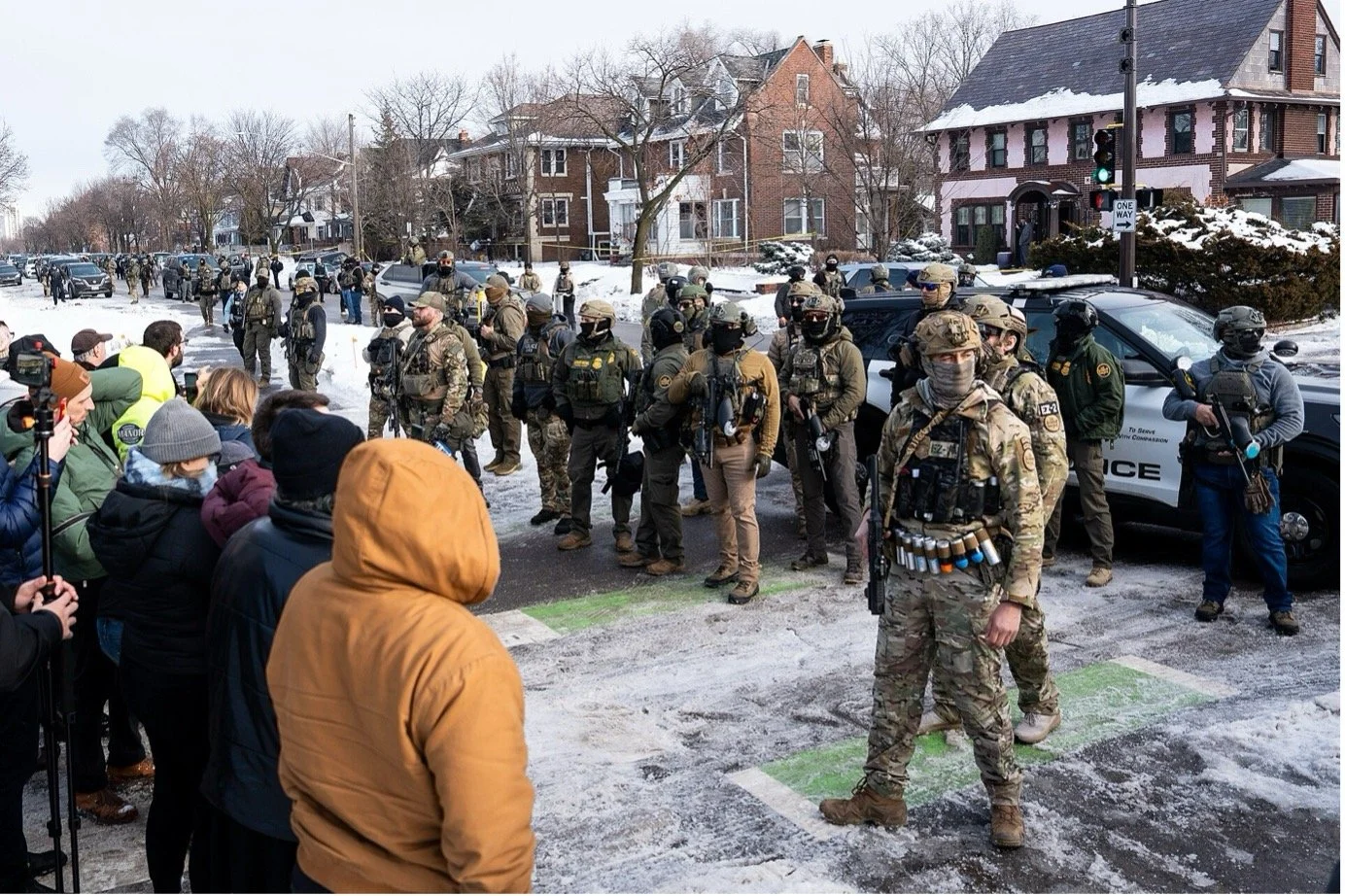
ICE agents in Minneapolis after shooting of Renee Nicole Good. Image courtesy of Chad Davis via Wikimedia Commons, ©2026. Some rights reserved.
The death of Alex Pretti only 17 days later tells a similar story. Pretti, a 37-year-old intensive care nurse, was described by family as a lover of the outdoors and mountain biking. His sister, Micayla Pretti, told the Associated Press that he was a hero who had “touched more lives than he probably ever realised.” A family statement indicated he had been upset by Trump’s immigration crackdown in Minneapolis and had joined related protests following Good’s death. Video footage from the scene shows a scuffle between Border Patrol agents and Pretti in the lead-up to the shooting. The DHS stated that agents fired in self-defence after Pretti, who had a handgun, resisted attempts to disarm him. Eyewitnesses, local officials, and family members have challenged that account, pointing out he had a phone in his hand, not a weapon. Police confirmed that Pretti was a legal gun owner, and filed testimonies from two witnesses note that they did not see him brandish a firearm.
More important than competing narratives or partisan rhetoric is the reality of the situation. Two people have lost their lives, families their loved ones, and friends their companions, all in the context of protest. This is a frightening concept.
America, long hailed as the bastion of the free world and the centrepiece of the liberal international order, no longer resembles the representative democracy it claims to be, but a country where events are censored, fabricated, and covered up to protect governmental aims and regime stability. A country where law enforcement organisations such as ICE are handed videogame-esque targets of how many people they can round up and detain in a day, and where valuable contributors to society like Alex Pretti and brave dissenters like Renee Good can lose their lives in moments of rash unpredictability. In this type of political environment, the lines between enforcement and authoritarianism begin to blur.
Under Trump, we can expect more of the same. He has created a world of his own. A political world seemingly bullet-proof from critique, judgement, or admission of wrongdoing. Because at the end of the day, what is truth? Truth is what he says is truth. Deny everything admit nothing. No matter how beaten you are, never admit defeat. That is and always has been the Trump way.
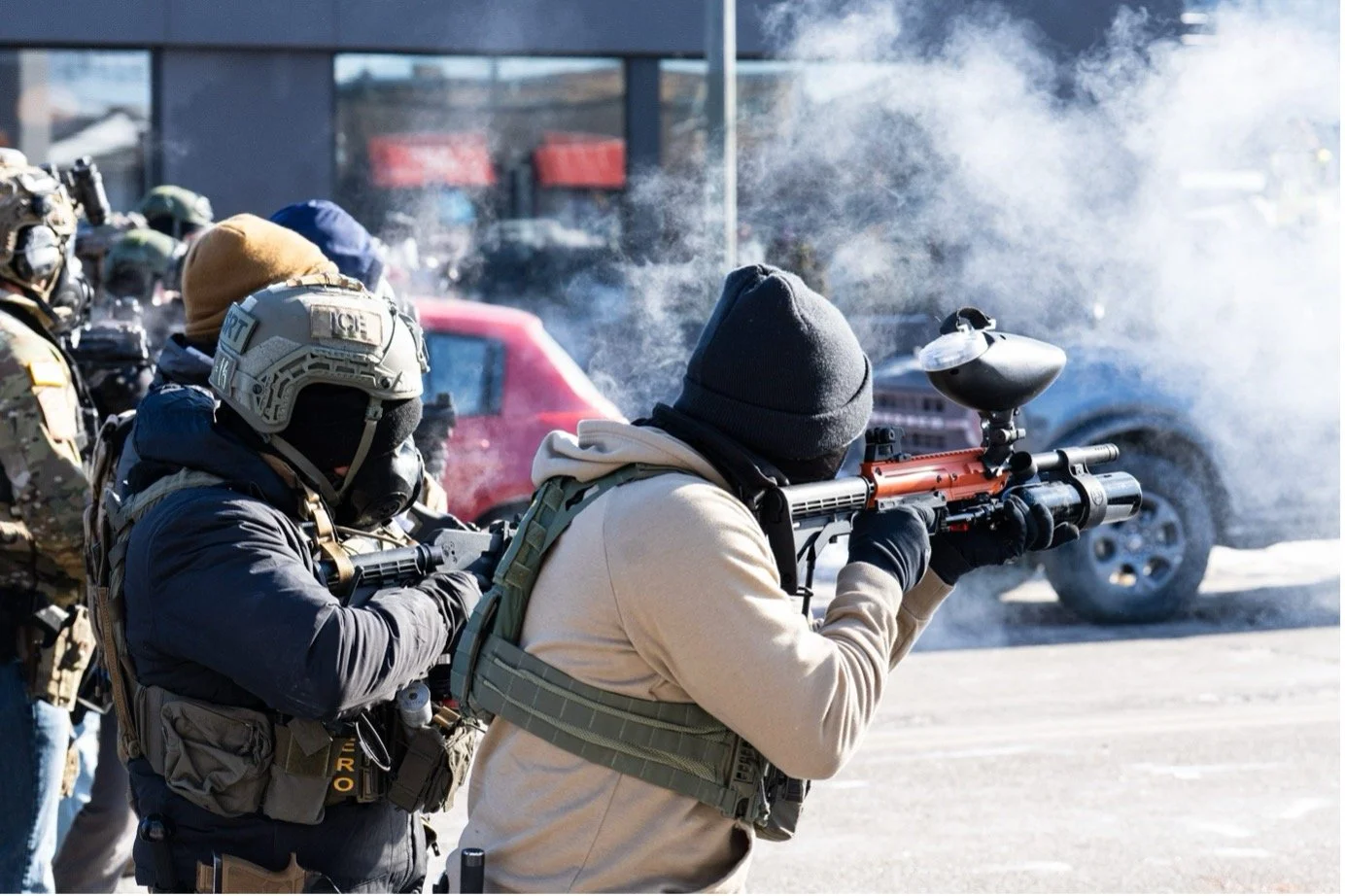
If current trends continue, the future of ICE is unlikely to resemble its early 2000s mandate. Expanded funding, broadened enforcement priorities, and increasingly militarised operations suggest an agency being revamped not merely as an immigration force, but as a central pillar of domestic security policy. In turn, these developments could foster deeper cooperation between federal immigration authorities and local law enforcement, embedding ICE more fully within the fabric of everyday policing.
Only time, and the decisions of future White House administrations, will tell whether ICE evolves into a permanently expanded domestic force or reverts back to something closer to its baseline level. What is already clear, however, is that the agency’s role in American public life is no longer peripheral. It has become a defining feature of the country’s political moment, and its trajectory is rapidly redefining the character of American freedom itself.
Image courtesy of Chad Davis via Google Images, ©2026. Some rights reserved.
The views and opinions expressed in this article are those of the author and do not necessarily reflect those of the wider St Andrews Foreign Affairs Review team.