Repeating The Past: Ethiopia on the Brink of Another War
In Ethiopia's northern Tigray region, a persistent sense of anxiety has permeated the daily lives of citizens, who have faced famine, violence, and conflict over the past eight years. The ethnic tensions fueling this insecurity erupted in 2020 with the start of the Tigray War, which lasted until 2022 and resulted in approximately 600,000 casualties. Earlier this year, renewed friction between the Ethiopian Army and Tigrayan forces led to the suspension of flights to Tigray, followed by strikes by government drones in the region. Although flights have resumed and the situation seems to have settled slightly, Ethiopia's foreign minister has accused Eritrea of military aggression in Ethiopian territory, reigniting antagonism after a peace deal in 2018.
The current state of affairs in Ethiopia can be traced back to the election of Prime Minister Abiy Ahmed following three decades of rule by the TPLF (Tigray People's Liberation Front). His governance was initially welcomed as a break from Tigray political dominance, and he was awarded the Nobel Peace Prize in 2019 for his efforts in resolving border disputes with Eritrea. However, his decision to postpone the national elections in 2020, allegedly due to the COVID-19 pandemic, resulted in claims of a “power grab”, and led to the TPLF holding its own parliamentary elections. With each group claiming legitimacy, relations between the central government and the TPLF worsened and ultimately led to war between the two factions. PM Abiy allied with the Fano, a coalition of militias from the Amhara region, as well as Eritrea, to topple the TPLF and centralize the country. After two years of fighting, the Ethiopian government and the TPLF signed the Pretoria Agreement, a peace deal mediated by the African Union.
However, the country has been anything but peaceful since the end of the war. Journalists and the media are regularly suspended and arrested. There have also been many reports from Tigrayans, both refugees and those who remain in the region, demonstrating high levels of violence and famine[AD1] . The former US Secretary of State Antony Blinken's accusation that PM Abiy's forces had committed acts of ‘ethnic cleansing’ in West Tigray seems to have carried over, as the Fano who are still in control of the area continue to brutalize the local population. This is not confined to Tigray anymore either: large parts of the neighboring region of Amhara have been taken over by Fano insurgents, who have been in conflict with the Ethiopian government since 2023. The government's regular civilian attacks have only encouraged more Amharas to defect to the Fano, deepening divides. The constant change of allegiances and entrenched ethnic disputes have fueled an environment of suspicion and randomized abuses, which will take more than enforced diplomacy to overcome.
Alongside the increasingly complex web of domestic clashes, the tension between Ethiopia and Eritrea threatens to completely destabilize the volatile Horn of Africa. The two countries were previously engaged in a war over their shared border from 1998-2000 with the dispute formally resolved in 2018. But Eritrea's exclusion from the Pretoria peace agreement and military aggression from both sides have fractured any chance at long term reconciliation. Ethiopia's desperate pursuit of sea access has also been a major concern, as PM Abiy has publicly acknowledged Ethiopia's rightful claim to a port on the Red Sea. The country already came into conflict with Somalia in 2024 over attempting to secure sea access in Somaliland, and has since been eyeing the Eritrean port of Assab. Satellite images show the expansion of a drone base in the nearby Ethiopian town of Bure. PM Abiy's relentless drive for geographic dominance has shown his true revisionist and confrontational character, which has upended Ethiopia's previous position as a status quo, stabilizing power. The force with which he operates has only become more aggressive since the end of the Tigray War, indicating the culture of hostility that has taken over East African politics.
Recent clashes between the TPLF and the Ethiopian government are early warning signs of a new war, with both sides unrelenting in pressure. The difference this time has been the reversal of loyalties, as the TPLF and Eritrean troops have been in contact, and have reportedly partially opened their shared border. The Fano and rebel groups from other Ethiopian states have also engaged in talks with the TPLF. These alliances are prone to disintegration, as they are not the result of a common goal but a series of individual grievances with the Ethiopian government.[AD2] Another new factor has been the outbreak of civil war in Sudan, which borders Ethiopia, and importantly Western Tigray. PM Abiy fears that a TPLF recovery of the region would create a weapon supply corridor between the two countries, as both the TPLF and Eritrea are allied with the Sudanese Armed Forces (SAF), and have provided soldiers and training to the army. On the other hand, it has been reported that Ethiopia has built a secret camp to train soldiers for the Rapid Support Forces (RSF) in Sudan, supposedly funded by the UAE. Both countries have declined involvement in the war. Another country that stands to benefit from an alliance with the TPLF and Eritrea is Egypt, as it harbors resentment over Ethiopia's construction of the Grand Ethiopian Renaissance Dam, and has strategic fears over Ethiopia's desire for Red Sea access. This vast network of friends and foes has only made the situation more volatile, as war in Ethiopia would almost certainly spiral into a regional catastrophe.
Ethiopia was broken down after its last war and does not stand in any position now to start firing on all cylinders again. The deterioration of its allegiances and exhaustion of its soldiers from years of fighting leaves it a shell of its former self, commanded by a man blinded by territorial greed and military domination. Its population, which already faced high levels of insecurity, has been further debilitated by Trump's USAID cuts and food shortages. Increased conflict will surely leave hundreds of thousands more dead without resolution. While a new war is not a given, without a change in PM Abiy's leadership, it does not seem likely that diplomacy will come to the fore of Ethiopia's governmental priorities.
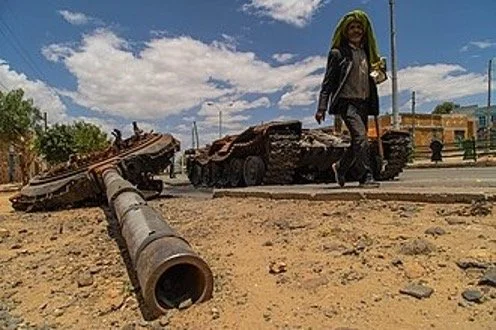
Image courtesy of Yan Boechat via Wikimedia ©2021. Some rights reserved.
The views and opinions expressed in this article are those of the author and do not necessarily reflect those of the wider St Andrews Foreign Affairs Review team.