The Stalemate in Myanmar, and what it means for ASEAN’s Future
Ever since Canadian Prime Minister Mark Carney’s fiery speech against the Trump Administration’s aggressive policies at Davos, there has been a global reconsideration of the emergence of “middle powers" on the international stage. Whilst much of the focus has been placed on the European Union, and it’s subsequent shift away from the Trump administration, we should also consider the emergence of other regional institutions within this same context. One such example is the Association of South East Asian Nations (ASEAN). Comprised of 11 nations in Southeast Asia, ASEAN has long been seen as the dominant regional authority, and a shift to a multipolar global system would no doubt result in the continued growth of ASEAN as a global power. However, there is a shadow that remains cast over ASEAN’s aspirations for a bright future: the civil war in Myanmar. The longstanding ethnic conflict between the central Tatmadaw government in Naypidaw and rebel groups scattered across the nation has resulted in significant political fragmentation and significant instability, undermining ASEAN’s claims for political centrality. ASEAN’s commitment to non-intervention (‘ASEAN Way’) has turned from a strength into a liability in the Myanmar crisis, undermining both its legitimacy and its strategic autonomy in an increasingly multipolar world.
ASEAN's response to the Myanmar civil war has exposed the structural limits of its foundational doctrine, revealing that the consensus-based non-interventionism of 'the ASEAN Way' is no longer capable of managing a crisis of this severity without incurring significant costs to the bloc's regional credibility.
As a regional entity, ASEAN diplomacy has historically been defined by “non-interventionism” and a respect for national sovereignty. This stance is the historical product of the creation of ASEAN within the post-colonial geopolitical environment of the 1960’s, which emphasized a “state-centric” approach to global affairs, perceiving stability as a product of respecting the authority and sovereignty of national governments. As a result, ASEAN countries have historically adopted a less confrontational, and more consensus-based framework to resolving disputes.
In terms of Myanmar and it’s longstanding instability, ASEAN has declined to condemn the regime, and has instead engaged in processes of eventual socialization of the regime back into the international system. However, in this most recent civil war, reports of indiscriminate attacks and human rights violations by the Tatmadaw government in Naypidaw have disrupted ASEAN’s positioning, as efforts to legitimatize the Tatmadaw government in line with the ASEAN way are sure to incur repercussions from the international community and the diminishing of ASEAN’s status as a regional authority. Furthermore, ASEAN has not pursued the recognition of the National Unity Government, recognizing that an NUG victory would include complete state collapse of the Tatmadaw, thereby causing detrimental crossborder instability, influx of migrants and refugees, resurgence of diseases such as HIV, tuberculosis and malaria, and the exponential increase of criminal activity; these costs are not ones that ASEAN states, in line with their state-centric viewpoint, are willing to take on. As a result of these constraints, ASEAN subsequently reverted to their historical neutrality and non-interventionism, passing the Five Point Consensus in April 2021, which stressed an end to hostilities and the emergence of a neutral political platform for discussions. However, this approach was largely ineffective, as the Junta vehemently rejected the policy under grounds of ASEAN’s emphasis on sovereignty as well as their own historical memory of incorporation into the bloc leading to a confidence in the eventual socialization of the regime back into the larger international system. Subsequently, the continued stalemate of the conflict, and the consolidation of junta strength being reinforced by international inaction, has led to increased pressure upon ASEAN from other international actors, who are calling for a rejection of Myanmar’s elections in Feburary 2026 and increased action against the Junta. Thus, ASEAN's foundational doctrine now faces a dual legitimacy crisis: its normative credibility is undermined by the appearance of tacit complicity in documented atrocities, while its functional credibility is eroded by the demonstrable failure of the Five Point Consensus to produce any measurable change in junta behaviour.
When applying this legitimacy crisis onto the global scale, the Myanmar stalemate not only erodes ASEAN’s legitimacy, but it’s member states’ capacity for strategic autonomy, as it generates a binary between Western condemnation and Chinese normalisation that leaves no viable non-aligned position. Historically, ASEAN has served as a means for it’s member nations to expand their influence via developing their “strategic autonomy” from both China and the United States. This was primarily expressed in ASEAN’s push for centrality in Southeast Asian affairs, which has been mainly expressed in it’s reliance on consensus viathe aforementioned “ASEAN Way”. However, the stalemate in Myanmar has exposed the fallibility of ASEAN’s centrality, as ASEAN’s inaction has created a regional power vacuum to resolve the issue. As a result, other states, namely China, have began to become more involved in the civil war, a decision spurred on by the threat of regional spillover effects and a desire to secure it’s southern borders. Whilst initially neutral, China has slowly begun to pursue recognition of the junta government, inviting Tatmadaw General Min Aung Hlaing to Beijing for high level talks in 2025 and sending observers to “legitimatize” the elections held in February 2026, alongside providing them with military support. In combination with Western condemnation and pressure on ASEAN to condemn the Junta, these two factors have reshaped the civil war in Myanmar into a state of global competition, thus constraining ASEAN’s strategic autonomy by framing either one of it’s decisions as a pathway towards aligning with the West or aligning with China. It should be noted that there is not a full dichotomy, as for the most part, the West seems to have “forgotten” about the Myanmar conflict, and largely, ASEAN states have moved to begin recognizing and engaging the junta government, for many of the same concerns that China exhibits regarding border stability and regional security. Thus, subsequently, some scholars have argued that there is an inherent shift within ASEAN towards becoming possibly more aligned with China due to possible alienation from the West as a result of the constant condemnation.
However, whilst this is true, the dichotomy argument gains considerable significance when considering the internal fragmentation of ASEAN as the states remain unable to construct a cohesive response to the issue, as Laos, Cambodia, and Thailand have began to push for the re-integration of the Junta regime, whilst Malaysia and Indonesia, among others, have stressed their commitment to the 5 Point Consensus, pushing for dialogue and conversation. This fragmentation can be considered as a reflection of the wider global conflict on the issue, with Laos, Cambodia and Thailand allying with the Chinese view of preserving regional stability, whilst Malaysia and Indonesia’s push for the 5 Point Consensus remains in line with the Western push for condemnation and non-recognition. That ASEAN's internal disagreements now mirror the contours of great power competition is itself the clearest evidence that the bloc's collective autonomy is being dissolved into binary competition.
In short, while ASEAN’s adherence to the ‘ASEAN Way’ initially appears to preserve regional stability and institutional cohesion, a closer examination reveals that this very framework has become the source of its strategic and normative decline in the context of the Myanmar civil war. The bloc’s commitment to non-intervention and consensus has not only failed to alter junta behaviour but has also fostered perceptions of complicity, eroding its legitimacy as both a moral and functional authority in Southeast Asia. At the same time, the prolonged stalemate has accelerated ASEAN’s loss of strategic autonomy, as internal fragmentation and external intervention increasingly draws member states into the orbit of competing great powers. Rather than maintaining its position as a central and independent actor, ASEAN now finds its unity weakened and its influence diluted, with its internal divisions reflecting the broader geopolitical rivalries it once sought to mediate. Ultimately, the Myanmar crisis provides a structural reckoning to ASEAN, raising critical questions about whether ASEAN can adapt its foundational principles to contemporary challenges, or whether it will continue to decline in both relevance and credibility within the regional and global order.
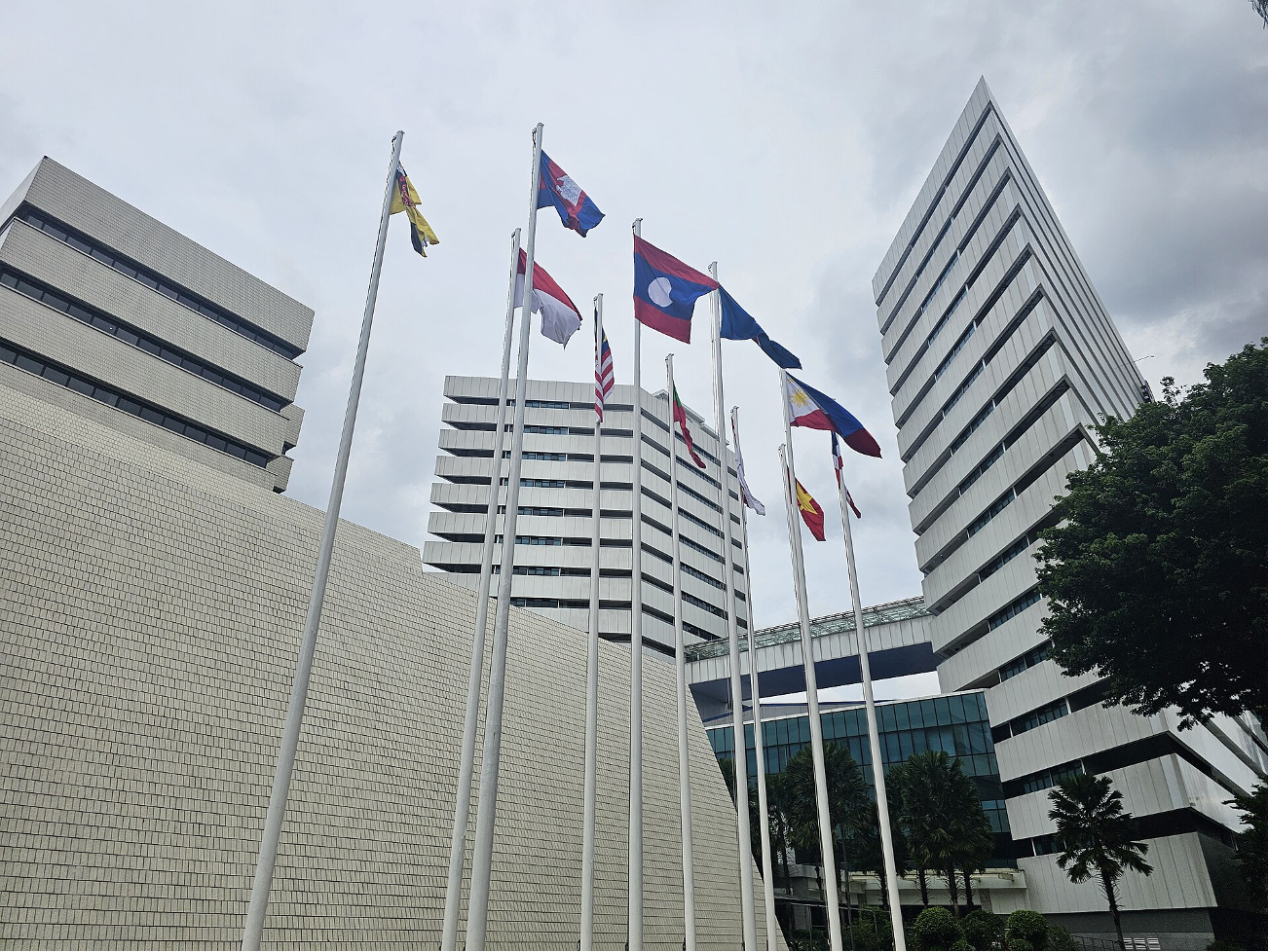
Image courtesy of Kaliper1 via Wikimedia Commons, ©2025. Some rights reserved.
The views and opinions expressed in this article are those of the author and do not necessarily reflect those of the wider St Andrews Foreign Affairs Review team.