The Fire Rekindled: The Rebirth of Zoroastrianism and Collapse of Political Islam in Kurdistan
There is a particular kind of courage required to look at a religion that has defined your culture for fourteen centuries and say, simply: no more. It is not the melodramatic courage of the battlefield, nor the performative bravery of the political speech. It is quieter, more internal, and ultimately more subversive than either — the courage of the conscience.
In the aftermath of the rise of ISIS and the fall of Mosul in 2014, a number of Iraqi Kurdish fighters and civilians found themselves confronting an awkward question: if this is Islam in its most militant and “authentic” form, what precisely are we defending? Some answered by drifting into atheism or irreligion. Others, more romantically or perhaps more strategically, reached backward in time—to the ancient creed of Zoroastrianism.
This theological and cultural transition is precisely what a growing number of Iraqi Kurds have been demonstrating since at least 2015, when, following centuries of disillusionment with Islam — accelerated dramatically by the rise of the Islamic State — many Kurds began converting to Zoroastrianism, an ancient monotheistic faith they consider native to their land and cultural identity. Once the official state religion of three Persian empires (Achaemenid, Arsacid and Sassanian) there are now thought to be less than 200,000 Zoroastrians worldwide. The religion has deep Kurdish roots. It was established at least as early as the mid-6th century BCE by Zoroaster, born in the Kurdish part of Iran, and its sacred text, the Avesta, was written in an ancient language from which the modern Kurdish language group derives. What is occurring in the hills and cities of Iraqi Kurdistan is not a crisis of faith so much as a correction of history — a people reaching back across a millennium of imposed theology to find something that feels, at last, like their own.
The high priest and his assistants wear white to represent purity, reciting verses from the Avesta, knotting a cord three times around the waist of each new convert to symbolize the faith's core values of good words, good thoughts, and good deeds. Against the backdrop of a movement that beheaded journalists on camera while invoking the name of God, this ritual simplicity is not merely appealing — it is devastating in its contrast. Mariwan Naqshabandi, the spokesperson for the Kurdistan Regional Government’s Ministry of Religious Affairs affirms that, “the people of Kurdistan no longer knew which Islamic movement, which doctrine, or which fatwa they should be believing in”. When a faith has been weaponized so promiscuously that it licenses the slaughter of Yazidis, the taking of their woman as prized slaves, and the desecration of ancient cities that predate the three major Abrahamic faiths, the instinct of the rational person is not to seek the correct interpretation. It is to walk away entirely.
Kurdish Zoroastrian leaders emphasize the primacy of science, gender equality, secularism in government, and peaceful coexistence — and they do so by comparing these values explicitly against what they describe as the perceived backwardness, misogyny, inherent political nature and violence of Islam, which many Kurds characterize as Arab imperialism and culturally alien to the Kurdish identity. Whether or not this is entirely fair to the vast majority of Muslims who fought against ISIS, have never detonated a car bomb or issued a death sentence for apostasy, the emotional logic is impeccable. People do not abandon religions because theologians refute them. They abandon them because the religion has been made to look monstrous in the public square and unapproachable in the global geopolitical arena.
The numbers are tricky, but local media reports in the region have suggested that at least ten thousand and no more than one hundred thousand Kurds converted to Zoroastrianism in a single year during the peak of ISIS atrocities. Considering that the population of Zoroastrians globally has never surpassed a quarter of million since its decline in the 8th century, these are figures that ought to concentrate the mind of anyone still laboring under the assumption that religious identity in the Muslim world is monolithic, immovable, or beyond the reach of historical events. It is not. It never was.
Zoroastrianism has been repackaged in Kurdistan as something like a civilizational birthright. Conversion centers have launched, fire temples (atashkadehs) have been built and ceremonies once extinct for centuries have been revived. The Kurdish Regional Government, with a pragmatism bordering on opportunism, has even granted official recognition to the religion. One should be clear: this is not a purely theological movement. It is political in the deepest sense—an assertion that Kurdish identity predates, and therefore supersedes, the Islamic overlay imposed by conquest in the seventh century. Indeed, many converts speak less about the supreme creator Ahura Mazda (Lord of Wisdom) than about authenticity. Islam, in this telling, is not merely a religion but an import—an Arab imposition that diluted Kurdish culture and subordinated it to wider imperial narratives.
Which brings us to Iran — and to the present catastrophe unfolding above its cities.
On February 28, 2026, the United States and Israel launched coordinated strikes against Iran, killing Supreme Leader Ali Khamenei and dozens of senior officials. The operation, which the Trump administration christened with the characteristically and cringeworthily grandiose name "Operation Epic Fury," has now entered its fourth week with no coherent endgame articulated and no serious diplomatic channel surviving. With neither side budging, the war is on an unpredictable path, the Strait of Hormuz effectively closed to commerce, and Iranian leaders publicly unbowed. The bombing of a girls' elementary school in the opening hours of the campaign, killing more than a hundred children, has already become the defining image of this conflict for the Iranian streets — whatever the forensic findings may eventually determine about its provenance.
Here is the question that neither the Pentagon nor the State Department appears to have spent serious time on: what does prolonged military destruction do to the relationship between a traumatized population and the theocratic state that claimed to protect them? In January 2026, Iranian security forces had already killed thousands of protesters in the largest demonstrations since the 1979 Islamic Revolution — a population already estranged from its government before the first American bomb fell. A regime that massacres its own citizens in January and then watches those same citizens incinerated by foreign missiles in March has rather thoroughly exhausted its mandate from heaven.
Among Iranian Kurds, the disillusionment is palpable. Many exiles openly state that they will not return home until the theocratic system collapses. Meanwhile, Kurdish factions—long fragmented—are once again contemplating coordinated action against Tehran, even as airstrikes and reprisals intensify the sense of crisis.
Iran was Zoroastrian before it was anything else. The faith of Cyrus the Great, of Darius, of the Achaemenid kings who permitted the Jews to return to Jerusalem — this was the spiritual inheritance of the Iranian plateau for a thousand years before the Arab conquest of the Sassanids in the 7th century imposed the Quran at the point of a sword. That history does not disappear. It hibernates. And catastrophe has a way of waking dormant things. Zoroastrianism is already an officially recognized (though extremely suppressed) religion in Iran, and its influence on subsequent monotheisms — including Islam itself — is woven throughout the intellectual history of the region. Here, the parallel with Iraqi Kurdistan becomes suggestive. If prolonged conflict further exposes the incapacity of Iran’s clerical regime—if it continues to deliver repression abroad and stagnation at home—it is not unreasonable to expect a broader ideological backlash. Not necessarily a mass conversion to Zoroastrianism (history rarely repeats itself so neatly), but a comparable rejection of Islam as a political framework, whether in its Sunni jihadist or Shiite theocratic variants.
And yet, one must resist the temptation to romanticize. The number of actual converts in Kurdistan remains modest; estimates vary wildly, and secrecy persists due to social pressure. Moreover, Islam is hardly on the verge of extinction among Kurds, let alone Iranians. But numbers are not the point. Symbols are. One need not be a romantic or a utopian to observe that when a government is destroyed from without while already collapsing from within, the ideological structures it rested upon tend to collapse with it. The Islamic Republic of Iran staked everything on a particular vision of political Islam. That vision has now produced: decades of sanctions, geopolitical isolation, and economic immiseration, a nuclear standoff that ended not in triumph but in rubble, a Supreme Leader (and self-described defender of the faith) killed in an airstrike, and a population that was already in the streets demanding something different before the bombs began to fall.
What we are witnessing is the erosion of Islam’s monopoly on meaning in a region where it once claimed total authority. For centuries, the choice was framed as Islam or nothing. Now, the options have multiplied: secularism, nationalism, revived pre-Islamic traditions. The very existence of alternatives is itself a form of dissent.
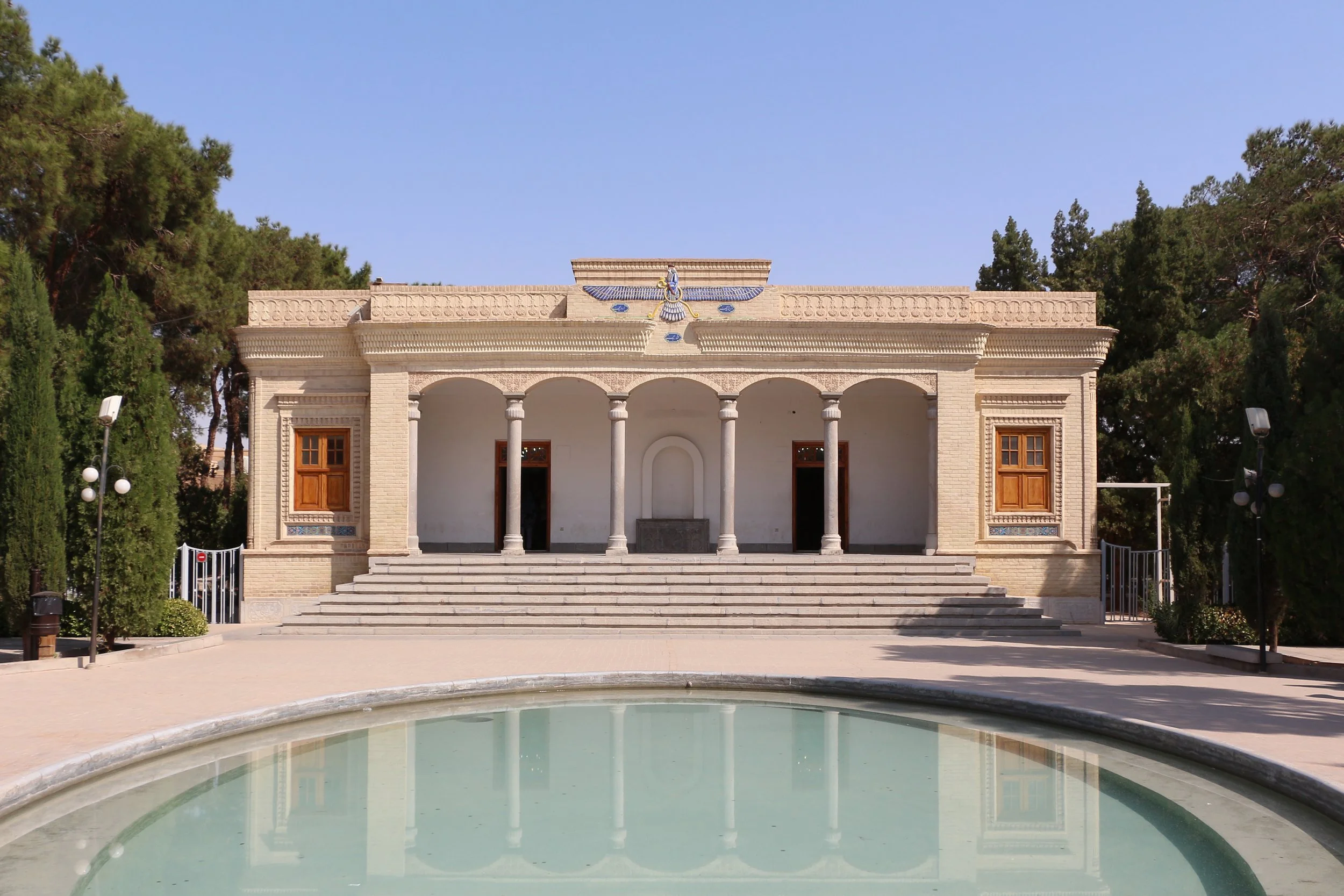
The Kurds of northern Iraq learned, through the intolerable pedagogy of the Islamic State, that a faith can be turned into an instrument of annihilation. The Kurds of Iran are learning, through a different and no less brutal school, that a faith entangled with state power becomes indistinguishable from that power — and inherits all its failures. The eternal flame of Zoroastrianism has burned, with a stubborn and almost insolent continuity, in the temples of Yazd for centuries—outlasting empires, invasions, and the confident predictions of its own extinction. It is, after all, among the oldest surviving religions on earth, which lends its present revival less the air of novelty than of historical correction. It may yet cast a longer shadow over the region it once dominated.
Image courtesy of Bernard Gagnon via Creative Commons, ©2016. Some rights reserved.
The views and opinions expressed in this article are those of the author and do not necessarily reflect those of the wider St Andrews Foreign Affairs Review team.