
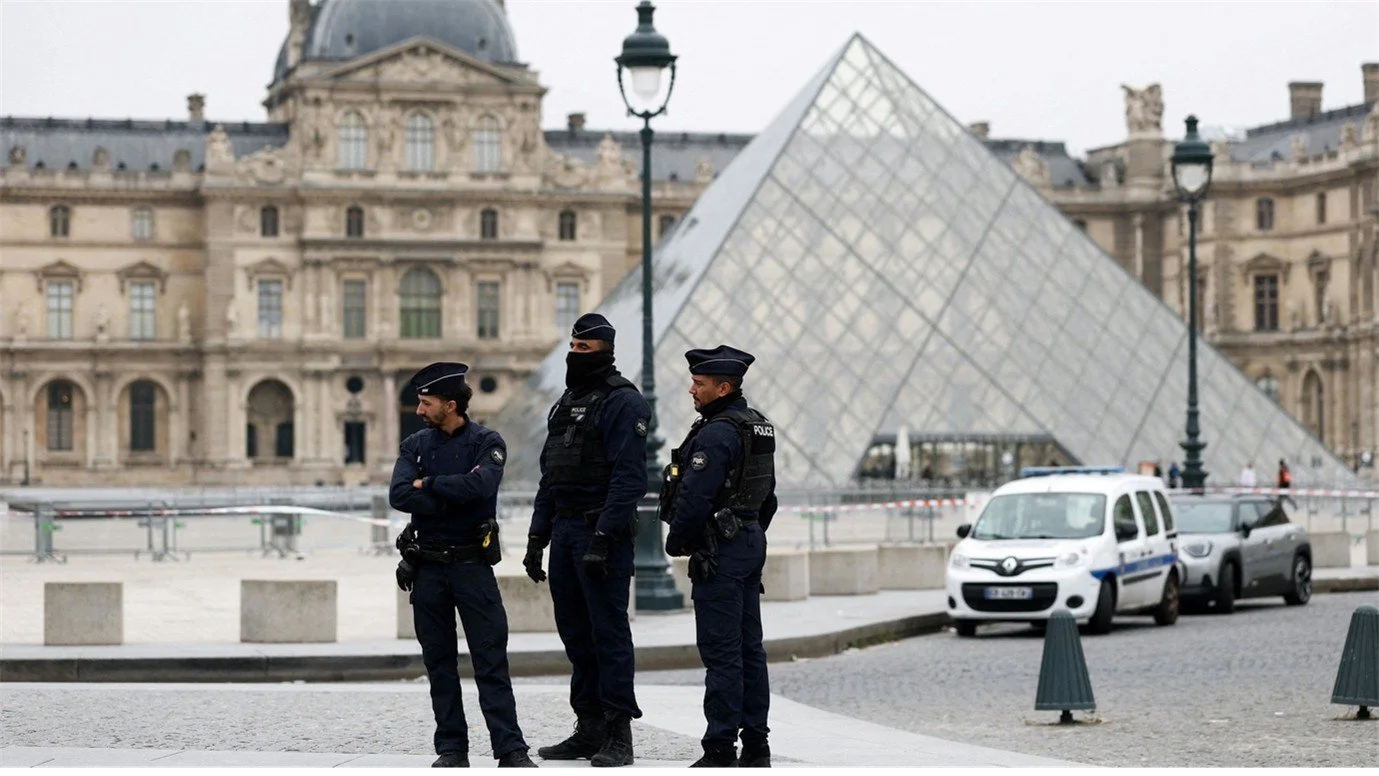
The Louvre Heist: A “Deafening Wake-Up Call” for the Protection of Cultural Heritage in the 21st Century
The Louvre is one of those landmarks that seems to embody a nation’s cultural soul. Just as Big Ben is to the United Kingdom, or the Colosseum to Rome, the Louvre is one of France’s own enduring icons. It is the most visited museum in the world, welcoming nearly 9 million people every year, and houses one of the world's most impressive art collections, including masterpieces like the Mona Lisa and, until recently of course, France’s former crown jewels. So, when news broke that a trove of some of the nation’s most valuable treasure had been stolen from one of its galleries, I was just as shocked as the rest of the world. A heist of this magnitude, in a place as seemingly impenetrable as the Louvre, just didn’t seem possible. Yet it happened—and far too easily at that, in broad daylight, during opening hours, and with visitors all around. The big question being how?
It has now been revealed that a Court of Auditors report, completed before the heist, warned how investments in maintenance and security were “indispensable for the long-term functioning of the institution”, yet the Louvre had consistently prioritised “visible and attractive” projects instead. Between 2018-2024, the report found that the museum spent €168.9m (£149.4m) on buying new artworks and developing exhibition spaces, but only €26.7m (£23.6m) on maintenance. This imbalance in spending has led to tangible consequences, such as just a quarter of one of the museum’s wings having CCTV coverage.
The report's head, French politician Pierre Moscovici, has subsequently declared the event as a “deafening wake-up call” for the “wholly inadequate pace” of safety and security upgrades at the museum, and these findings echo criticisms raised elsewhere. France’s culture minister, Rachida Dati, has said that managers “grossly underestimated” the dangers of intrusion into the museum, while leading art expert Didier Rykner has accused the Louvre of preferring to spend its "abundant" resources on eye-catching initiatives rather than on the basic protection of what it already has. Moscovici’s message ring’s loud and clear: the Louvre had sufficient funds for the improvements and “must now implement them without fail”.
Another shocking detail is the heist’s speed, with officials saying that the thieves were inside the gallery for only four minutes, with the entire robbery over in just seven. Indeed, the museum had already been open for 30 minutes, welcoming hundreds of visitors through its doors, when at 09:30 local time the gang arrived in a van fitted with a mechanical ladder. Two of the four thieves, disguised in hi-vis vests to look like builders, then climbed to a balcony overlooking the Seine using the mechanical ladder, and cut through a first-floor window with power tools to gain access to the Galerie d'Apollon (Gallery of Apollo). Inside, they threatened guards, smashed two display cases, and then fled with the crown jewels—unsuccessfully attempting to torch their van while escaping on scooters.
Unsurprisingly this event has sparked a political outcry in France. President Macron himself has condemned it as "an attack on our history", while far-right National Rally leader Jordan Bardella has called it “an unbearable humiliation for our country”. Citing the museum’s curator, a French public prosecutor has said that the masked thieves successfully stole eight objects now valued at a staggering €88m (£78m). These include:
A sapphire tiara, necklace, and earring set linked to 19th-century queens Marie-Amélie and Hortense
An emerald necklace and earrings once belonging to Empress Marie-Louise, Napoleon Bonaparte’s second wife
A pearl and diamond tiara, reliquary brooch, and corsage-bow brooch belonging to Empress Eugénie, wife of Napoleon III
Leading experts are saying that the robbery was a clear example of how thieves have started targeting cultural institutions not necessarily for their prized paintings, but for artefacts that can be dismantled and melted down for their expensive parts. “What we’ve definitely seen in the last five to seven years is some more shift towards raw materials theft” explained Remigiusz Plath, the secretary of the International Counsel of Museum Security. High-profile artworks are nearly impossible to sell. Their fame makes them instantly recognisable, and legitimate buyers or auction houses won’t go anywhere near them. This has pushed thieves toward objects with intrinsic material value. Items that can be stripped of their identity and traded for their raw worth rather than for their cultural significance. There are growing fears that this may already have happened to the jewels stolen from the Louvre.

The stolen emerald necklace once belonging to Empress Marie-Louise, Napoleon Bonaparte’s second wife. Image courtesy of Wikimedia Commons contributors via Wikimedia Commons, ©2025. Some rights reserved.
At first, given how effortlessly the thieves pulled off the heist, it seemed as if officials almost wanted to believe that they were dealing with highly sophisticated criminals or a wider organised crime network. Reflecting this assumption, the case was handed to a specialist police unit known for its strong record in cracking high-profile robberies. “This won't be their first heist," echoed Dutch art detective Arthur Brand, supported by French magistrate Laure Beccuau who said that the thieves were likely “acting for the benefit of a sponsor” or obtaining precious stones to carry out “money laundering operations". And yet, at the time of writing, it is now believed that the heist was executed by local “petty criminals” from the banlieue’s of Seine-Saint-Denis, an area north of Paris that is one of the poorest in France.
These developments come after investigators found that the thieves left a trail of evidence behind including tools, gloves, and DNA traces on both their van and the glass cases containing the jewels. A sophisticated group would likely have taken far more precautions. Also, a ninth piece, Empress Eugénie’s crown, containing more than 1,300 diamonds, was later found outside the museum after being dropped during the escape, a blunder that further points to the group’s inexperience. Furthermore, the profiles of the current suspects reflect none of the expertise typically associated with a heist of this scale. Rather than the Ocean’s Eleven-style masterminds authorities initially anticipated, these individuals’ backgrounds reveal histories of minor offences, such as petty theft and traffic-related charges.
This serves as a striking blow to France’s national image. Landmarks like the Louvre are more than just tourist attractions. They function as crucial instruments of soft power, demonstrating the strength of a country’s national pride and cultural heritage. France depends on institutions such as the Eiffel Tower and the Louvre not only for the significant amounts of revenue they generate each year, but for the prestige they lend to its international standing. The fact that jewels so integral to France’s royal legacy could be stolen by apparent amateurs, in broad daylight, poses a serious threat to this standing, undermining the credibility of the country’s role as a global cultural leader. Many questions remain unanswered. Why were the windows not better reinforced? Why was the only camera monitoring the Gallery of Apollo pointing away from the balcony the thieves used to break in? If a museum as prominent and well-funded as the Louvre has allowed such basic lapses in security to go unchecked, this signals a worrying complacency—one that may point towards a much deeper problem of infrastructural vulnerability. While security has reportedly been tightened around the nation’s cultural institutions since the incident, if vulnerabilities like this existed at the Louvre, who is to say that other French landmarks are any less at risk. Senior figures will undoubtedly be concerned about what might be targeted next, while governments around the world will be watching closely and re-examining the safety of their own national treasures.
This should prompt a broader reckoning in the international community. Cultural artefacts are increasingly seen not only as historical relics but as strategic assets. Their protection is no longer just a matter of domestic policy—it is part of how nations present themselves to the world and build trust with international partners. It is also how they can justify the ownership of historical artefacts and negotiate the repatriation of any lost possessions. France is a country that has historically resisted calls from the international community to return contested pieces, despite its imperial and colonial past. This reflects an attitude that has arguably been enabled by the cultural legitimacy and influence the country wields through its soft power. Now France faces a serious reputational dilemma, as its failure to safeguard its own treasures at home undermines any claims to cultural stewardship in the global arena. In this way, the Louvre heist is more than just a theft, it is a moment of international reflection on how seriously we treat the guardianship of cultural heritage in the 21st century.
President Macron, however, seems to have other ideas- unveiling his ambitious €800 million ‘Louvre Renaissance’ project earlier this year, including the dedication of an entire gallery solely to the Mona Lisa. In the wake of this dramatic saga, rather than pouring hundreds of millions into further cosmetic enhancements, I would suggest that those funds might be better spent on safeguarding what the Louvre already possesses. After all, people will still queue for hours to see the Mona Lisa whether or not she gets a new room, but France’s royal jewels may now be lost forever.
Image courtesy of heute.at via Google Images. ©2025. Some rights reserved.
The views and opinions expressed in this article are those of the author and do not necessarily reflect those of the wider St Andrews Foreign Affairs Review team.