France 2027: A turn to the Far Right?
As Emmanuel Macron nears the conclusion of his second term as President of France, speculation about his successor is growing. Since his election in 2017, the French political landscape has fundamentally realigned itself, further polarizing its main actors and disrupting the left-right duopoly. For decades, the far-right party Front National, renamed Rassemblement National (RN), was treated as disruptive within French politics and unable to command executive power. Nevertheless, since the debate concerning security affairs and immigration regulation has increased in the past few years, the RN has solidified its presence as a likely contender for the French leadership. Its de facto leader, Marine Le Pen, achieved historic results following the 2022 Elections. She lost the election with 41.45% of suffrages in the second ballot, the strongest performance by the far right surpassing her father’s results in 2002.
What does the far right bring to the table?
One of the main questions we need to assess to understand the rise of the far right is why the far right resonates so deeply with parts of the population?
The Rassemblement National successfully positions itself as the party representing traditional France or “La France traditionelle”. It thus claims to be the defender of peripheral and rural areas of France facing economic underdevelopment in contrast with urban cities.
Surveys by the Institut Français d'Opinion Publique (IFOP) consistently show that the RN draws disproportionately from working-class voters and employees in precarious work.
Additionally, the RN successfully taps into anxieties about national identity, secularism and immigration – portraying themselves as the necessary option to counter the supposed cultural decay France is going through. Further intensified after the 2015 Paris Terrorist attacks, the narrative of French society being directly threatened by Islam was widely exploited by the far right in the following years. The constant use of this cultural threat narrative brings up closely linked conversations on security.
Rising crime and urban insecurity have been central themes in the RN’s political messaging and policy proposals. This is where the party advanced some of its most mainstream arguments, bleeding into the platforms of center-right parties as well. The RN makes the argument that open border policies have a direct causal link to increase in violence and crime, following similar political frameworks as adopted by Nigel Farage and the Reform Party. This framing allows the party to appear as the only political actor capable of restoring order and security within the country.
What is the state of the opposition?
Seemingly, the main opponent party facing the RN in the upcoming elections seems to be La France Insoumise (LFI), a far-left party whose leader Jean Luc Melenchon narrowly missed the runoff for the second ballot at the 2022 elections. His polarising leadership style and controversial positions on NATO and Ukraine alienates some centrist left voters. With an electoral demographic of young, urban and diverse backgrounds, LFI appears to be the strongest left-wing party to counter the rise of the far right.
On the other hand, moderate left-wing parties have become minor in French politics. The Socialist Party (PS) suffered from the shift from presidential leadership to a marginal force. This was accelerated by Francois Hollande’s unpopularity during and after his presidency (2012-2017). The rise of Raphaël Glucksmann as a potential figure for PS revival seems of significance; they were able to achieve good results during the European election results in 2024. Nevertheless, it is still unclear whether the PS can reclaim an independent identity or remain subordinate within left coalitions.
The past month has revealed the struggles faced by the opposing left. The adopted narrative that frames LFI as the far left equivalent of the RN creates a false symmetry. Additionally, Macron asserting his position as a barrier between two extremes contributes to this narrative that further polarizes the political landscape. In turn, this delegitimises the left and contributes to the fragmentation of the French left wing.
The state of Far-right leadership:
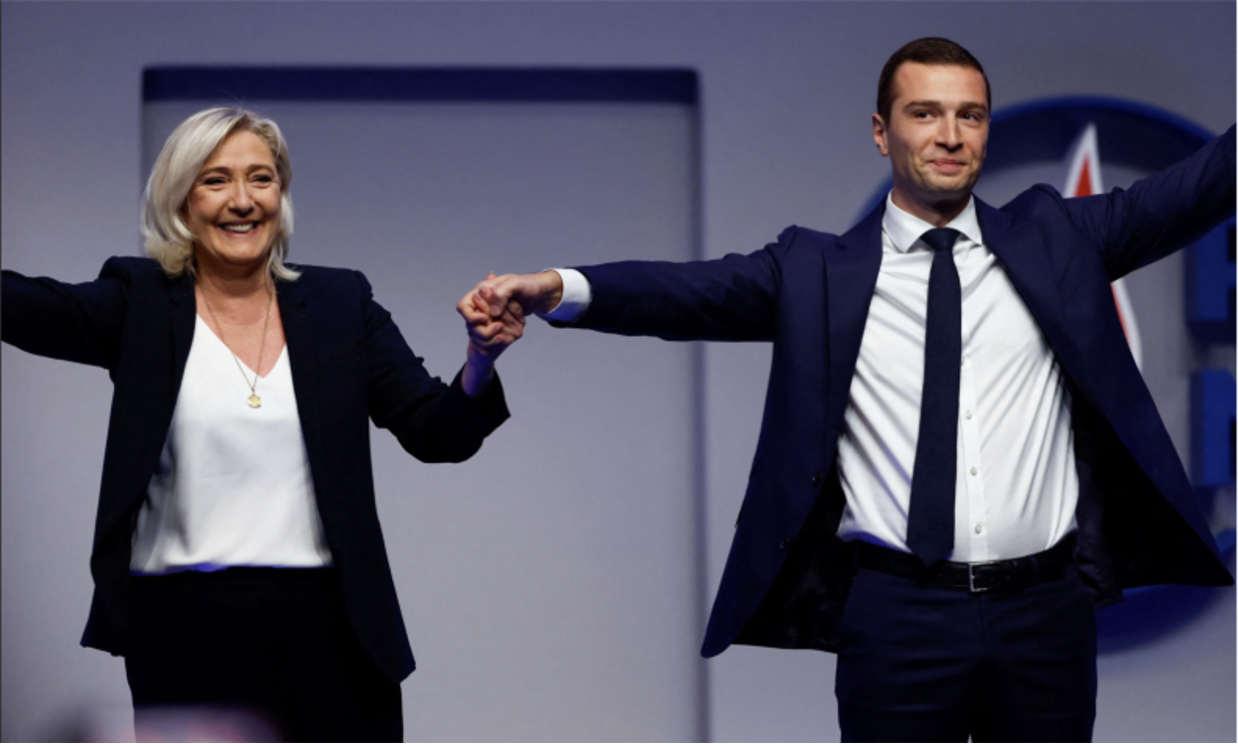
While the current rise of far-right ideals within French politics strongly indicates that they are serious contenders for the 2027 French presidential election, Marine Le Pen’s political future has become uncertain. Facing a possible five-year ineligibility following her conviction in March 2025 for the embezzlement of EU funds, the RN is considering alternative leadership from other party officials such as the party president Jordan Bardella. Nevertheless, it remains unclear whether Bardella has the capacity to lead a presidential campaign without Le Pen’s personal legacy.
Comparisons with the broader European far-right surge, particularly the leadership of Giorgia Meloni in Italy and the rise of the Alternative für Deutschland in Germany, further strengthen the momentum of French far-right mobilization regardless of Le Pen’s fate.
Current trends indicate a likely shift toward the far right in the 2027 presidential election. To counter this, left-wing groups will need to mobilize effectively while the center-right will have to present a convincing successor to the President Emmanuel Macron.
Image courtesy of Christian Hartmann via Reuters, ©2025. Some rights reserved.
The views and opinions expressed in this article are those of the author and do not necessarily reflect those of the wider St Andrews Foreign Affairs Review team.