What the Retirement of the Mercator Projection Says about the United States’ Foreign Policy Goals
In early September of this year, the UN general assembly approved a resolution to transition away from the Mercator projection and towards adoption of the more accurate Equal Earth map. Many people are probably already familiar with the fact that while the Mercator projection is probably what comes to mind (or first in a Google search) for ‘world map’, it vastly overrepresents the size of land mass north of the equator and underrepresents the south, particularly the African continent. It also happens to be nearing its 458th birthday. Given these facts, making the updated Equal Earth map the new standard seems to be a no brainer.
However, the recent resolution was only one vote off from unanimous. The US continued its recent streak of ‘no’ votes, opposing the adoption. In a written explanation, a US representative stated:
‘Instead of focusing on genuine problems of international peace, prosperity, or good relations, this body is debating map projects from the 16th century, and their role in promoting reparations and “cognitive justice”.’
I would argue that the real primary purpose of updating the map is that it is a project of the 16th century. After all, it would be quite surprising if the UN, a body famous for somehow both over-deliberation and inability to form a consensus, passed the resolution because the other 164 members agreed on the definition of ‘cognitive justice’ and a way to bring it about. The motion sponsored by Togo and supported by the African Union was no doubt conceived in response to the inequality of the Mercator projection. However, I think it is unlikely that it passed because 164 countries wholeheartedly adopted the ideology behind it. I think far more probable is the possibility that land size matters to states so much less today than in eras past that only one country saw any reason to put up a fight about how we perceive it.
Gone is the era of exploration, invasion, and expansion when sheer mass was one of the primary contributors to state power. Today natural resources such as minerals and oil, technological capabilities, military capacity, and trade relationships determine material power far more accurately. However, if you still subscribe primarily to the smaller = weaker, bigger = stronger metric, the retirement of the Mercator projection does seem like a blow to the prestige of the previously overinflated countries and continents.
This brings us back to the one ‘no’. President Trump favors a hyper-personal style of governance that leads me to believe US opposition in the UN is a reflection of White House policy. Without attempting to psychoanalyze, I would like to point out that Donald Trump spent his formative years at the tail end of the age of empire. Even more concretely, he often publicly obsesses over land size. Commenting on Greenland during his first term he observed:
‘I love maps. And I always said, ‘Look at the size of this. It’s massive, and that should be part of the United States.’
On the Mercator projection map, Greenland dwarfs the United States. In reality, the US is more than double the size in square kilometers.
In attempting to rationalize the near-invasion of Greenland in the early stages of Trump’s second term, other administration officials pointed out that aside from its Mercator-enhanced vastness the island offers a security foothold for the US to ward of Russian encroachment into the Arctic as well as vast mineral resources. While true in essence, both these explanations come with massive stipulations. The United States did have some military access to Greenland, and their new agreement released late September reads more symbolic than as a policy shift. As for mineral resources, news outlets and Greenlandic leaders have pointed out that the US is more resource rich overall and mining or drilling in Greenland is probably too logistically complicated to be profitable at scale.
To summarize, there is no truly logical reason for the US to be annexing Greenland and the impulse from the Trump White House probably stems in part if not in full simply from its apparent size. This offers an explanation for American opposition to the Equal Earth update. Not only does it shrink the US, but it makes a main foreign policy goal of this term far less straightforward. This begs the question of whether while the rest of the UN member states are moving past a land and empire-based model of the international system, the US is not only stuck but possibly regressing. The answer to this question is worth considering not only as a thought exercise but because the rest of the world can hardly hope to succeed with the US (as either an ally or adversary) in the near future without speaking the same language.
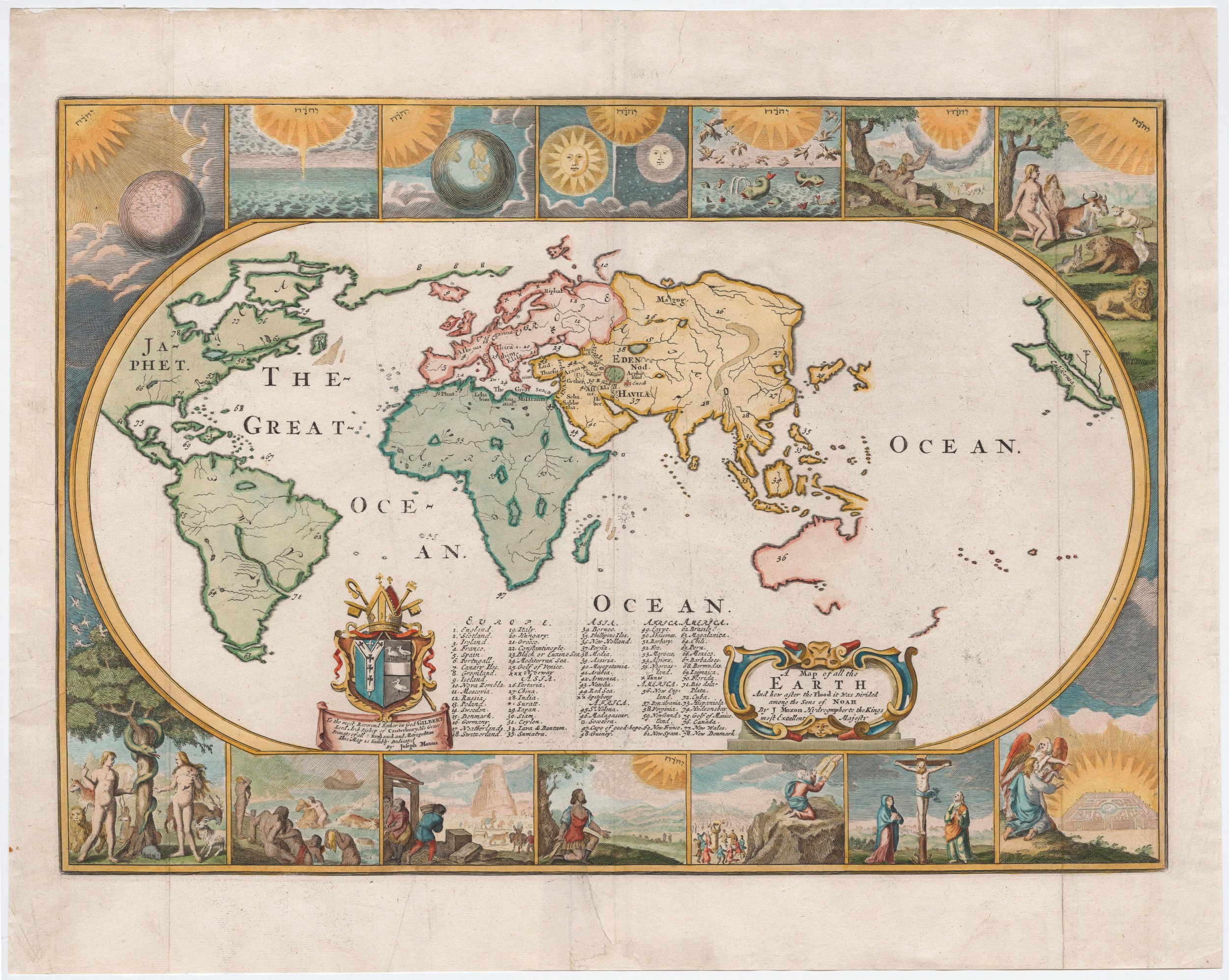
Image courtesy of Joseph Moxon via Wikimedia Commons, ©1681. Some rights reserved.
The views and opinions expressed in this article are those of the author and do not necessarily reflect those of the wider St Andrews Foreign Affairs Review team.