Russian Hybrid Warfare Evolves as the Kremlin Responds to the Ukrainian War
When reading the news, it is easy to see articles detailing cyber-attacks, disinformation online and suspicious deaths as isolated incidents. Understanding Russian hybrid warfare allows one to connect these incidents, constructing a broader concept of the overarching strategy the Kremlin utilises to destabilise Western society.
As Russian leadership faces increasing military and domestic pressures resulting from the Ukrainian war, the Kremlin has evolved its strategies of hybrid warfare to provide tactical benefits for the war effort. Hybrid warfare, a strategy of warfare attributed to Russia since the 2014 annexation of Crimea, has had its priorities shifted from interfering with Western states to sabotaging essential military supply chains to Ukraine.
This evolution is significant as it highlights not only the growing threat Russia poses to Western infrastructure and defence industries, but the capability of the Russian leadership to adapt its hybrid warfare strategy to achieve its geopolitical aims. Successfully limiting the impact of hybrid warfare requires a strong understanding of the Kremlin’s objectives, capabilities alongside a knowledge of its military and domestic considerations.
This article begins with an examination of existing research on Russian hybrid warfare, identifying how Russia has constructed their strategy up to 2025. By analysing the August 2026 Leipzig airport sabotage attempts, I argue how this incident indicates the evolution within the Russian strategy, drawing from other related incidents within 2026. Following, I explain how the military challenges on the frontlines and the domestic struggles have pressured Russian leadership into prioritising progress in the war with Ukraine over the enduring goal to destabilise Western society.
Hybrid warfare, a term developed by Frank Hoffman, recognises the “blurring of conflict” as modern war takes place beyond the linear methods of military-on-military warfare (2007, p. 7). Hybrid warfare is the simultaneous application of various methods of regular and irregular warfare; linear examples include direct military intervention, proxy wars, and supporting insurgents to incite civil war. Crucially, hybrid warfare also includes irregular warfare. Russian irregular methods include, but are not limited to, violation of international law, disinformation campaigns, cyber warfare, targeted assassinations, state-sponsored terrorism, sabotage, espionage and surveillance.
Use of irregular methods below the threshold of war can be strategic choice by political leaders. Academics and policymakers pose that the Kremlin conducts such activities within Western nations while obfuscating direct state involvement, granting plausible deniability – often shrugging off accusations as ‘Western propaganda’, ensuring the threshold of direct war with West is not reached. Russia continues to operate within the “grey zone” to destabilise and limit capabilities of Western powers through initiating, provoking and furthering internal tensions. Disrupting Western states through hybrid warfare achieves the strategic objective of restricting the growth of Western society – namely the liberal institutions, norms and military presence – towards Russia’s borders, which analysis argue is Russian President Vladimir Putin’s perceived foremost existential security threat.
Since the invasion of Ukraine in February 2022, Russia contributed significant resources towards conducting hybrid warfare in Western states. For example, between 2022-23, three anti-war Russian journalists have been suspected of being poisoned by Russian agents in Munich, Tbilisi and Prague respectively. In 2023, a defected Russian soldier was shot and run over by a car after relocating to Spain, with Spanish intelligence attributing responsibility to the Russian state or hired criminal proxies. In September 2025 an estimated 23 Russian unarmed military drones entered Polish airspace which triggered a NATO Treaty Article 4 invocation by Polish Prime Minister Donald Tusk.
Within the UK, Russian operatives have been linked to the May 2025 arson attacks against properties associated with then Prime Minister, Sir Keir Starmer, alongside the regular violation of maritime law as Russian ships spy on key British infrastructure in the North Sea. These incidents are barely scratching the surface of the extent of activities conducted by Russia within Europe since the February 2022 invasion. The Russian hybrid warfare strategy of 2022-25 is seen as a performative demonstration of capabilities visible to Western leaders and citizens to intimidate dissidents and destabilise Western nations.
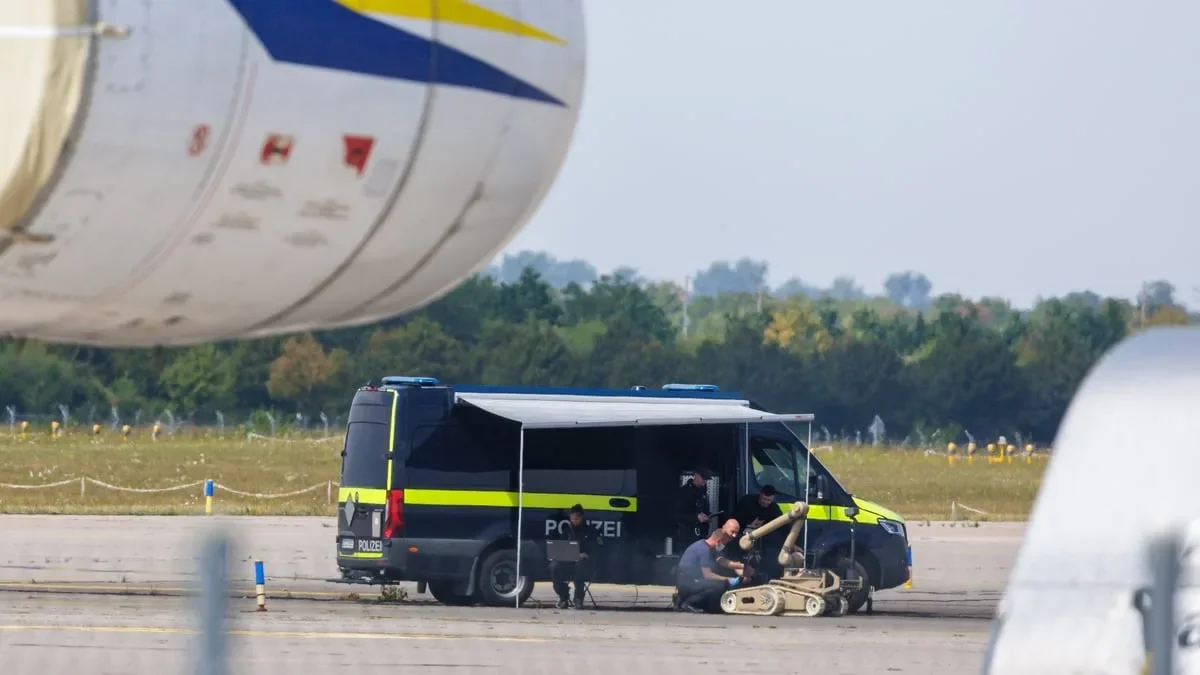
On the night of 4 – 5 August 2026 an employee of Leipzig/Halle airport spotted a drone between Ukrainian cargo planes. It was confirmed by police that the drone was armed with explosives, forcing the runways into lockdown as a robot was deployed to remove the detonator. During the same night, a DHL cargo plane collided with a second suspected drone while in the air, sustaining minor damage. Ten days later, on 14 August, a third drone was found to the west of the airport in a nearby field, with 50 grams of military-grade explosives found at the site. The attempted sabotage at Leipzig airport exemplifies an evolution of Russia’s hybrid warfare strategy, as objectives within Europe have shifted from performative to tactically valuable to the Russian effort in the war with Ukraine.
Initial media speculation immediately linked the sabotage attempts to Russia, as the German Interior Minister Alexander Dobrindt stated “we can’t rule out the possibility that foreign powers are behind this". On 1 September, the German government formally accused Russia, with Dobrindt confirming “we [Germany] are a daily target of hybrid warfare”, with the findings proving that “persons acting on behalf of Russian government agencies” were responsible. Russia has denied any involvement, with President Putin claiming evidence was “planted”, citing German economic struggles as a motivation for constructing the false narrative as a diversion.
Leipzig has been a previous target of Russian sabotage, as in 2024 a package fitted with an incendiary device burst into flames at the DHL cargo hub. Alongside the DHL centre, Leipzig operates as a major munitions and military equipment hub for Germany and NATO and the base of Ukrainian Antonov Airlines – which carries a majority of Ukraine’s military cargo. The strategic value of Leipzig/Halle for European security has made a key target for Russian disruption.
The Leipzig airport attack adds to evidence of the increased sabotage efforts within Europe within 2026. Similar suspected sabotage incidents have been recorded in France, Czechia, Italy, Bulgaria and Estonia in 2026 at key defence sites that deliver to Ukraine. The Defence Intelligence of Ukraine in October 2026 warned the EU and NATO of “intensification” of Russian sabotage efforts against “military facilities, infrastructure, communications, and Starlink stations… aimed at undermining aid to Ukraine and weakening the Alliance’s capabilities”. The methods of 2022-25 are not being entirely replaced, however, the increase in sabotage incidents across Europe within 2026 signals an evolution of Russian hybrid warfare away from a primarily performative act of disruption in powerful Western states to a tool of strategic military benefit.
The current military situation of the Ukrainian war and internal dynamics within Russia present a new challenge for the Kremlin. This challenge has required an evolution of hybrid warfare to achieve tactical benefits in the Ukrainian invasion.
Over the summer, Ukraine has had significant success with its drone attacks, with deep strike technology allowing Ukrainian forces to successfully target key infrastructure and logistic resources, such as oil refineries and Wildberries factories. These factories are comparable to Amazon warehouses in the West, with successful strikes disrupting domestic supply chains of public goods, while also harming military capabilities, as these factories are suspected of storing Russian munitions and equipment. Therefore, success of Ukrainian strikes while Russian troops struggle to make ground on the frontlines and sustain heavy casualties has resulted in tactical sabotage being necessary to alleviate the direct military pressures.
Furthermore, the internal pressures the Kremlin face have required a prioritisation of ending the Ukrainian war over the strategy of Western destabilisation. The September 2026 State Duma election results represent both a vote of confidence and an increase in expectations on Russian leadership. The State Duma, Russia’s legislative assembly, held elections for the first time since the invasion of Ukraine. United Russia, Putin’s party which has maintained power since 2001, increased their majority from 324 to 349 of 450 seats. President Zelensky of Ukraine claimed in July that Putin intended to mobilise 300,000 – 500,000 more troops from October, with the first wave of 120,000 reserves moved into units confirmed. The results of the Duma elections will likely reinforce Putin’s desires for further military action, despite previous waves of protests across Russia as reserves have been summoned for war.
As winter draws closer, Putin and the Kremlin are aware that progress of the fronts will slow further and the demand for energy and resources will rise on both sides. The Ukrainian attacks on oil refineries have exacerbated the domestic energy and cost of living challenges Russia has been facing due to enduring sanctions. BBC’s Russian editor Steven Rosenberg has analysed Russian newspapers, which despite their strict monitoring by the Kremlin, detail the “deterioration of the economic situation” with Rosenberg’s public interviews highlighting the “growing pessimism” towards the war. Therefore, the evolution of hybrid warfare is a reaction to the military and internal pressures Russia faces, the Kremlin recognises the need to achieve significant tactical progress aiding the war efforts in Ukraine.
In conclusion, Russian hybrid warfare is a dynamic strategy which the Kremlin employs to achieve its geopolitical goals. The Leipzig airport sabotage attempts alongside other evidence of recent months indicate hybrid warfare has evolved from a strategy to disrupt and destabilise the West into a tactical tool to assist the war effort. This evolution is explained by the recent Russian difficulties on the frontlines and at home within 2026.
Russia’s hybrid warfare will continue to generate news stories which one must place into the puzzle to see the full picture of the Kremlin’s strategy. For the West to successfully protect itself from these threats, policymakers, journalists, academics and researchers must construct a clear image of Russian geopolitical ambitions and how hybrid warfare can be harnessed to achieve these goals. These cannot be considered, however, without nuanced contemporary analysis of the military situation on the frontlines and recognition of the internal pressures facing Russian leadership.
Image courtesy of Jens Schlueter via Getty Images, ©2026. Some rights reserved.
The views and opinions expressed in this article are those of the author and do not necessarily reflect those of the wider St Andrews Foreign Affairs Review team.
