Italy's Love for MAGA and the Politics of Appeasement: Giorgia Meloni's friendship with Donald Trump
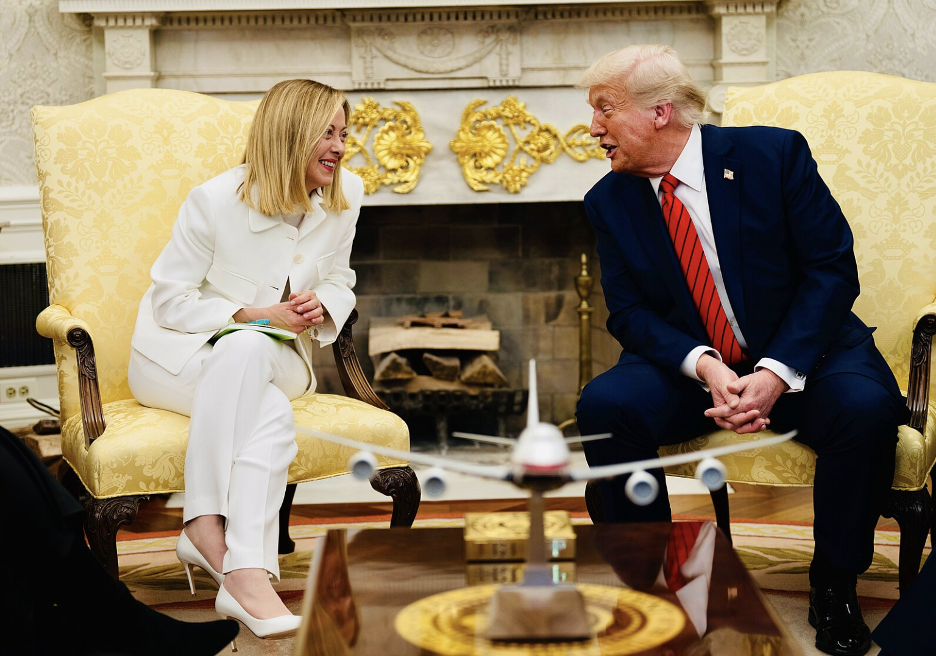
”Where is she... there she is. You don’t mind being called beautiful, right? You are”. The comment, made by Donald Trump to Italian Prime Minister Giorgia Meloni at the Gaza peace summit in Egypt this past October, was met with polite laughter from a room filled with world leaders gathered to discuss the urgent situation in Gaza. In the context of a pressing humanitarian crisis, the moments revealed more than the United States president's inclination for theatrics. As cameras began to focus on Meloni smiling through the crowd, Trump continued: “I’m not allowed to say it.. In the United States.. That’s usually the end of your political career, but I'll take my chances"; a scene a bit awkward and symbolic of the disbelief regarding the fact that Meloni, having gained political authority in Italy as a woman, is deemed as “incredible”. Trump's affection towards the female leader stems from Meloni’s cultivation of a friendship defined by admiration, emulations of his rhetoric, and defenses of his allies in the name of personal loyalty. In fact, her affiliation with Trump is deeply controversial, reflecting patterns of appeasement, flattery and willingness to compromise domestic interests to preserve an alliance whose significance is rooted in Italy’s history, revealing how national pride begins to coexist with external dependence.
Since their first meeting in Paris, Meloni has attempted to carefully present herself as Trump's continental confidante – efforts that have been met with success considering her definition as “Europe’s Trump whisperer”. The US president has openly described her as the European leader he feels he can "work with to straighten out the world”, comments that further underscore Trump’s determination to align himself with like-minded leaders as opposed to the broader, negotiated frameworks of multilateral diplomacy. This archived role flatters Meloni’s image as a woman who rose from working class Rome to occupy the European spotlight and Trump’s approval. Meloni undoubtedly has ideological affinities with the US’s president, considering their shared views on immigration, LGTBQ, abortion, and her opposition to gendered ideology that echo Republican-led culture wars. Yet, her country’s stability and security are inextricably connected to the EU. This connection reveals why an alliance with the US has always been pivotal for Italy and its insurance policy against French and German dominance of the EU, reasons for which Meloni has become a pragmatic performer working to reconcile nationalist pride with the weight of geopolitical reliance, all while protecting Trump’s political ego abroad and ensuring sovereignty at home.
This role as the bridge between Trump and the EU stands with significant risks, for in attempting to play both sides, Meloni risks isolation and weakening Italy’s credibility and influence on the international stage. Moreover, Meloni’s planning is based on past essential national concerns; her own rise is deeply rooted in post-2015 tensions, when Italy – overwhelmed by the Mediterranean migrant crisis – felt abandoned by its European partners. Specifically, Fratelli D’Italia hard-line stance on immigration has employed public frustration, demonstrating that her firm pro-EU presentation is less an embrace of Brussels, and more a vision of a Europe aligned with her own priorities: tighter borders, stronger national sovereignty, and reduced technocratic oversight — traits that directly echo Trump open far-right agenda. These objectives reveal the prime minister’s calculating ways and focus on admiring an individual man, thus disguising submission as strategy with a significant element of theatrical populism.
On this note of theatricality, her endorsement of the MAGA world extends beyond Trump himself. When Vice President J.D Vance attacked European values at the Munich Security Conference promoting EU criticism, Meloni publicly defended him, revealing yet another preference and loyalty towards US leaders promoting nationalist conservatism and hostility towards supranational governance. Such attitudes indicate the female leader’s projection of herself within a global conservative revival, even if it risks forming tension between Italy and its European partners. She thus continues to reinforce her transatlantic allegiance that also directly shapes her domestic perception; for instance, after the assassination of American activist and Trump supporter Charlie Kirk, Meloni mourned him as a “martyr of “Western freedom” and warned of vast left wing conspiracies targeting political conservatives. Her strong stance on Kirk’s further accentuated her idolisation of Trump, as both men are symbols of the far right, a rising not unnoticed by the Italian population considering events such as photo of a three-word graffiti at the Turin train station, with messages reading "Meloni like Kirk. Once again displaying confidence and radicality, the leader continued to condemn unseen enemies seeking intimidation, while defining her association with Kirk as a "source of pride.” Following this recognition, it is safe to assert that Meloni’s public addresses and social-media tributes blurred the line between political solidarity and self-victimisation, mirroring Trump’s language of persecution and antagonism. Still, her devotion does not remain immune to controversy considering that 83% percent of Italians — and 77% of her party’s voters — believed the American president exhibits dictatorial or authoritarian tendencies, views failing to diminish the admiration for his despotic charisma.
This respected charisma, however, reflects measurable costs: Italians are increasingly lamenting how Meloni’s loyalty to the US President implies negligence and detriment to the state's domestic interests. When Trump imposed 107 % tariffs on Italian pasta imports, threatening €671 million in exports, Meloni dismissed the concern, claiming the impact would be limited. Opposition figures, such as Democratic Party leader Elly Schlein, accused her of “fake patriotism,” describing how an authentic nationalist’s duty is to defend domestic producers rather than fixating on placating a foreign ally. Nevertheless, Meloni refrained from open criticism — an act of restraint that emphasizes her overall priorities: ideology over interest, loyalty over leverage. Moreover, Schlein specifically framed Meloni’s behavior as an inability to say to no Trump, noting she also accepted demands such as the expectation of NATO allies to lift defense spending to 5% of GDP, a figure that could divert €445 billion from Italy’s welfare budget, and supported an exemption for U.S. tech multinationals from the EU’s global minimum tax. Such gestures reinforce the same pattern of appeasement justified as partnership, and the image of submission framed as strategy.
Consequently, consensus intensifies around the argument that in this context of trade war, Meloni is ultimately incited to leverage her personal ties with the U.S. president to “save the transatlantic alliance”, advocating for a global order based on shared institutions and norms that maximize benefits in European and Italian interests. Yet, Meloni persists in echoing the call to “make the West great again,” a slogan rebranding nostalgia as strength. The irony is stark: in employing Trump’s language of sovereignty, she undermines the collective frameworks that Italian fought to construct following the country's crucial detachment from post-war fascist tendencies and its shunning of far- right parties.
In fact, “Fascism seems to be a subject that Meloni cannot escape”, considering her dramatic campaign promises and radical stances even as she reassures Brussels with fiscal restraint while tightening control over Italy’s judiciary and press. Her consolidation of executive power thus has always suggested a feared rise of authoritarian leaders, but this reality remains structurally based on imitation with even symbolic gestures reinforcing the perspective and its incoherences. Case in point, experts continue to warn that for Meloni, “agreeing with Trump takes precedence over respecting national historical facts”, emerging from additional manifestations like her public praise for his supposed reinstatement of Columbus Day as proof of “shared heritage,” even if, as stressed, Italy continues to pay the economic and political costs of this alignment.
Once the time for applause was over, the image revealed at the Gaza summit lingered: Trump smirking, Meloni grinning, and audiences recognising a moment that spoke louder than the speeches presented. Ultimately, Italy’s love for MAGA represents more than diplomatic admiration and directly mirrors Europe’s perpetual struggle between autonomy and American dependence. Meloni’s fixation on securing praise from Mar-a-Lago proves just how much practices of appeasement remain prevalent in current global politics.
Image courtesy of The White House ©2025. Some rights reserved.
The views and opinions expressed in this article are those of the author and do not necessarily reflect those of the wider St Andrews Foreign Affairs Review team.