
Hypersonic Munitions are Critical to Ensure American Military Dominance
There is a school which encourages the United States to meet mass with mass in its acquisition programs. This line of thinking is flawed and should be circumvented in favour of preferencing precision and speed in the United States’ munitions acquisitions; ergo, the United States should lean into advancing its long-range hypersonic munitions portfolio. Utilising hypersonic munitions, missiles that marry speeds of over five times the speed of sound with significant flight manoeuverability, would afford the United States greater operational flexibility in its grand strategy: short, quick strikes that disorient, sabotage, and destroy the United States’ adversaries from a distance is crucial to end conflicts with the United States as the victor.
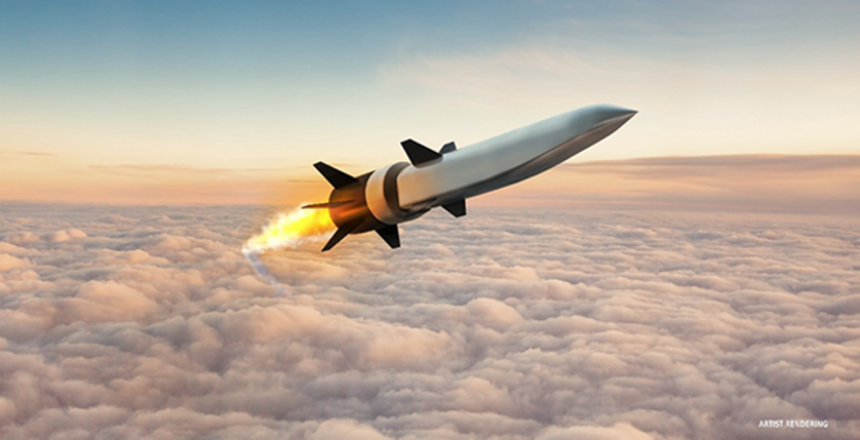
The development of the Dark Eagle, a Lockheed Martin and Northrop Grumman joint project, is one of the most promising advancements in the hypersonic weapons. The hypersonic missile serves as the common two-stage booster for the Army's Long-Range Hypersonic Weapon (LRHW) and the Navy's Conventional Prompt Strike (CPS) system, which can be fired from both surface vessels and submarines. The Dark Eagle has a reported range of between 1,725 miles and 2,175 miles and a speed that can exceed Mach 5, or nearly 4,000 miles per hour.
As evident from the Dark Eagle’s specifics, the main advantage of hypersonic missiles is their ability to be fired at a distance. Conflicts are determined by the ability to strike beyond the range of the adversary’s defenses. Take a potential US-China conflict over Taiwan, for example: senior US military leaders have argued that should China invade Taiwan, the United States military would be forced to abandon the first island chain and instead fight from the second island chain, encompassing Guam, Hawaii, and the rest of American territories in the Indo-Pacific. As such, the Pentagon should prioritize range over mass in this scenario. With hypersonic missiles, the United States would be able to do just that: the LRHWs and CPS produced by America’s industrial base can field high tech hypersonic munitions.
Additionally, the United States Navy has outfitted its Zumwalt-class warships, the world’s most advanced destroyers, with missile tubes compatible with hypersonic munitions. By focusing on these capabilities, the United States would be able to strike from a greater distance against a peer navy, not only at their ships but also at the anti-access and anti-denial defence systems that China possesses.
There is also greater combability with current air platforms being developed. The Trump administration has promoted the development of Boeing’s F-47, America’s sixth generation aircraft. In tandem with the F-47, hypersonic munitions can be fielded from the American mainland and conduct strikes against enemy ships, critical infrastructure (electrical grid), and strategic targets- such as China’s Ream Naval Base in Cambodia or Beijing's naval communications network. With the use of hypersonic missiles, the US can integrate a robust long-range offensive strategy which can effectively shatter their adversaries' defences and dominate the playing field.
Hypersonic munitions would also counter the argument of cost-effective mass weapons systems for future military acquisition. Observers of the Ukraine War have relentless advocated for the need to produce at scale solutions which would negate the cheap rapid field drone technology employed by both Russia and Ukraine. They have placed fault in the United States’ pursuit of legacy and experimental weapons. However, this argument is flawed: who is to say that drone warfare will be the template for future wars? Observers, particularly the media, have overemphasized the effectiveness of drone technologies. Iran’s Shaheed drones, the very same employed in the Ukraine War, were inconsequential against American B-21's and F-16s during Operation Midnight Hammer.
Through swift and direct attacks, hypersonic munitions would easily bypass the slow moving, individually controlled FPV drones so uplifted by some members of the security establishment. Furthermore, with their inability to be accurately predicted and their overall destructive payloads, hypersonic would terrify the United States’ adversaries. A hypersonic boost-glide missile would probably be detected at launch, if the adversary had space-based infrared sensors with the ability to do so and in the correct position. But the difficulties of tracking the boost-glide missile through its lower-altitude flight, combined with its much greater ability to change direction, mean that potential adversaries would not know where the final target is. How would they be able to effectively counter a missile which can outpace all weapons? The United States’ adversaries would balk at the notion of confronting a United States armed with such lethal weaponry.
As with most new technology, hypersonic comes with financial considerations. According to the Congressional Budget Office, fielding hypersonic would come at a substantial cost to American taxpayers. CBO estimates that hypersonic boost-glide missiles would cost about one-third more than comparable ballistic missiles. Procuring 300 intermediate-range hypersonic boost-glide missiles like the ones being developed by the Army and the Navy and then sustaining the missile system for twenty years would cost a total of $17.9 billion in 2023 dollars. CBO offers ballistic missiles, equipped with maneuverable reentry vehicle technology, as a cheaper alternative. 300 ballistic missiles with the same speeds, ranges, and targeting capabilities as those hypersonic missiles would cost a total of $13.4 billion.
This point is moot: the United States has a robust industrial base which would, should it continue to develop such weapons, reduce the overall cost of the missiles. The US contract manufacturing base is already producing precision electronics at volumes that dwarf military demands. These companies maintain sophisticated quality control and security protocols and offer elastic capacity that can surge when needed. Furthermore, the foundation they provide for weapons assembly could be complemented by component technologies for software, rocket motors, warhead chemicals, and automated manufacturing and 3D printing pursued by a new generation of US defence startups. Additionally, Secretary of War Pete Hegseth’s acquisition transformation strategy has promoted the idea of incorporating more defence firms within the defence industrial base. In a word, America’s strong industrial base would quickly reduce the costs on account of the laws of free market competition and the desire to make profits.
However, financial constraints are of concern for investing in hypersonic production. Based on defence appropriations bills passed in the past, there has been weak support for appropriate funding for both hypersonic research and acquisitions. In FY26, the Senate only appropriated $115 million to accelerate development of the ‘Multi-Mission Affordable Capacity Effector’ (an advanced, hypersonic air-to-surface missile). Although this is a start, MACE missiles are only compatible with aircraft such as some variants of the F-35 Joint Strike Fighter, and not with Zumwalt class warships or even the Virgina class submarines within America’s arsenal. Furthermore, the Senate appropriated $1.9 billion for ‘critical munitions’, which include HIMARs, Stingers, and Javelins.
It would be detrimental to American interests to withhold appropriatefunding for hypersonic and instead, say, dedicate funds for missiles and missile platforms to donate to Ukrainians free of charge as it would impact America’s overall commitment towards revolutionizing its arsenal. Only through constant innovation and development of new weaponry can the United States ensure its military dominance and thus thwart the ambitions of their adversaries. Opting for hypersonic munitions which, although slightly more costly than the cruise missiles, would offset the price tag due to their greater precision and destructive capabilities supplementing America’s strong assertive military doctrine.
Image courtesy of DARPA via Wikimedia © 2021. Some rights reserved.
The views and opinions expressed in this article are those of the author and do not necessarily reflect those of the wider St Andrews Foreign Affairs Review team.