Bad Bunny and his Politics of Love
The image of Puerto Rican singer, artist and rapper Bad Bunny covering his eyes - overcome with emotion at the Grammys after winning Album of the Year - quickly became a poignant symbol, both online and offline, of how far the artist has come, and the gravity of his achievements.
Few could argue that 2025 was artist Benito Antonio Martínez Ocasio’s year. From releasing his sixth studio album Debí Tirar Más Fotos [I Should Have Taken More Photos] in January, to only months later being announced as the headlining artist for the 2026 Super Bowl halftime show just months later, Bad Bunny has accumulated a string of career-defining milestones that show no sign of slowing.
He made history at the Grammys walking away with the award for ‘Album of the Year’for Debí Tirar Más Fotos-the first album sang entirely in Spanish to win the award - having already taken home Best Música Urbana Album earlier in the evening.
During his acceptance speeches, the singer made his political stance unmistakeable, and declaring ICE was not welcome in the USA, stating “ICE out” and affirming that “We're not savages, we're not animals, we're not aliens, we are humans and we are Americans.”
This referred to the administration’s choice to deploy ICE agents acrossMinneapolis and other parts of the state, detaining civilians, and using force against groups including peaceful protestors, all the while villainizing immigrants and communities of colour.
In an American political climate marked by deepening polarisation, an emboldening of the US Immigrations and Customs Enforcement (ICE) agency’s actions, the growth of hate speech, far-right extremist racist and anti-immigration rhetoric, the artist has made it pointedly clear that his music can, and has always been, profoundly political in nature. Not just that, but that as an individual, his public persona may serve as a useful unifying tool that may serve as a counter towards an increasingly divisive and hateful political sphere.
In an American political climate marked by deepening polarisation, an emboldened ICE, and the rise of far-right, racist and anti-immigration rhetoric, Martínez Ocasio has made it clear that his music is, and has always been, profoundly political. Beyond that, his public persona has emerged as a unifying force against an increasingly divisive and hateful political sphere.
One may be forgiven for believing —incorrectly—that Martínez Ocasio only recently forayed into the political sphere. Yet an analysis of his musical trajectory reveals that he holds his identity, and the importance of speaking out about politics, as inseparable from his music and wider international image.
Bad Bunny is no stranger to political statements, or to standing up for what he believes in,an ongoing trend in his musical endeavours. Just three years after he first went viral on SoundCloud in 2016, he became widely recognised as one of the biggest Spanish-speaking singers, and soon after, one of the most consistently popular and widely listened-to artists in the world.
In late 2018, he spoke out about the devastation Hurricane Maria brought to Puerto Rico, killing thousands in the commonwealth alone, displacing hundreds of thousands, and causing damage to critical infrastructure. Bad Bunny chose to bring awareness to the issue during his performance on ‘The Tonight Show Starring Jimmy’ Fallon. His 2024 song Una Velita, released seven years after the hurricane, memorialises the disaster, which was met with notable indifference by the Trump administration. In doing so, the singer placed himself in direct opposition to an administration that has largely dismissed the scale of destruction faced by Puerto Rican citizens.
He has also been praised for his use of fashion to counter restrictive expectations of hyper-masculinity, and the use of his music to raise awareness of the unacceptable number of women who fall victim to sexual and gender-based violence (SGBV).
In 2024, the singer chose to make his political views known. His actions have already shed light onto socio-political issues facing his hometown. He forayed into Puerto Rican politics by endorsing Juan Dalmau, the leader of the Alianza party, a coalition between the Puerto Rican Independence Party, and the Citizens Victory Movement, for the gubernatorial race. (Jenniffer González Colón ultimately won).
The Puerto Rican artist’s Super Bowl halftime show was highly politicised from the moment it was announced. Donald Trump’s presidency has seen him and the MAGA movement consistently espouse hateful rhetoric which has villanised communities of colour and immigrants, using dehumanising language, and likening those in the state to “aliens” and “animals.”
This ultimately led to the development of an ‘alternative’ halftime Super Bowl performance— the All-American Halftime Show, by Turning Point USA, a conservative nonprofit. Rooted in xenophobia, this opposition ultimately manifested in the insistence of the All-American halftime show to have an exclusively English setlist. Trump supporter, Laura Loomer posted that Bad Bunny’s show “wasn’t White enough for [her].”
Martínez Ocasio’s performance at the Super Bowl was groundbreaking in its interpretation and earnest celebration of American culture. His entirely Spanish setlist, a first for Superbowl history, had been politicised deeply in the run-up to his performance.
The fact that his global tour included performances across the world, and in Puerto Rico, but none in the USA may initially seem striking, but was motivated by concerns about ICE proving a notable security hazard by potentially targeting fans, and most notably, a belief that performing in the USA, as he told Variety, had become “unnecessary.” Evidently, Bad Bunny’s political stance encapsulates more than just a unifying message. He also appears set on challenging American cultural dominance and hegemony and holding a mirror to increasingly displaced American soft power. Indeed, the New Yorker argued that Bad Bunny’s halftime performance in particular worked to both celebrate - and critique - American pop music, depending on the perspective of the viewer.
By the end of the halftime show, what could be termed the performer’s ‘politics of love’ had become visible. This was owing to his choice to end his performance with what The Independent termed “a pan‑American call for unity”. This took the form of a concrete reconceptualisation of ‘America’ as the nations across North, Central and South America, as well as the Caribbean. He ended his show with the phrase ‘God Bless America’ and listed numerous states in the region, while featuring their respective flags — highlighting the various unique national and cultural identities across the region.
Numerous political commentators have noted that Bad Bunny’s performance served a profoundly political goal. Rather than the dominant Western conception of ‘America’ as referring to the state (the USA), Bad Bunny’s performance situated the USA within its geographical context —as ultimately one state amidst many across two continents —challenging the long-held cultural hegemony, and arguably, as a result, the imperial dominance that the USA has held over the Western hemisphere. Most notably, Martínez Ocasio did so in a way that didn’t attack dominant narratives of American identity, but by bringing the distinct, and often overlooked, Puerto Rican identity to centre stage instead. The performance resonated with fans across the world, and can be considered an earnest celebration of identity.
Amidst a cultural climate where the responsibility for celebrities to speak out against political injustice is perpetually contested, Martínez Ocasio provides a defiant, empathetic and powerful answer. He suggests music can be an effective tool in political unification, help to emancipate and strengthen his community, and act as a way for people to stand up against horrific injustices facing marginalised communities on a daily basis.
His belief that “the only thing more powerful than hate is love,” a phrase he chose to end the Super Bowl halftime show with, emblazoned on a screen, is a profound and succinct expression of his “politics of love,” which, in today’s political and cultural climate, grows only more urgent.
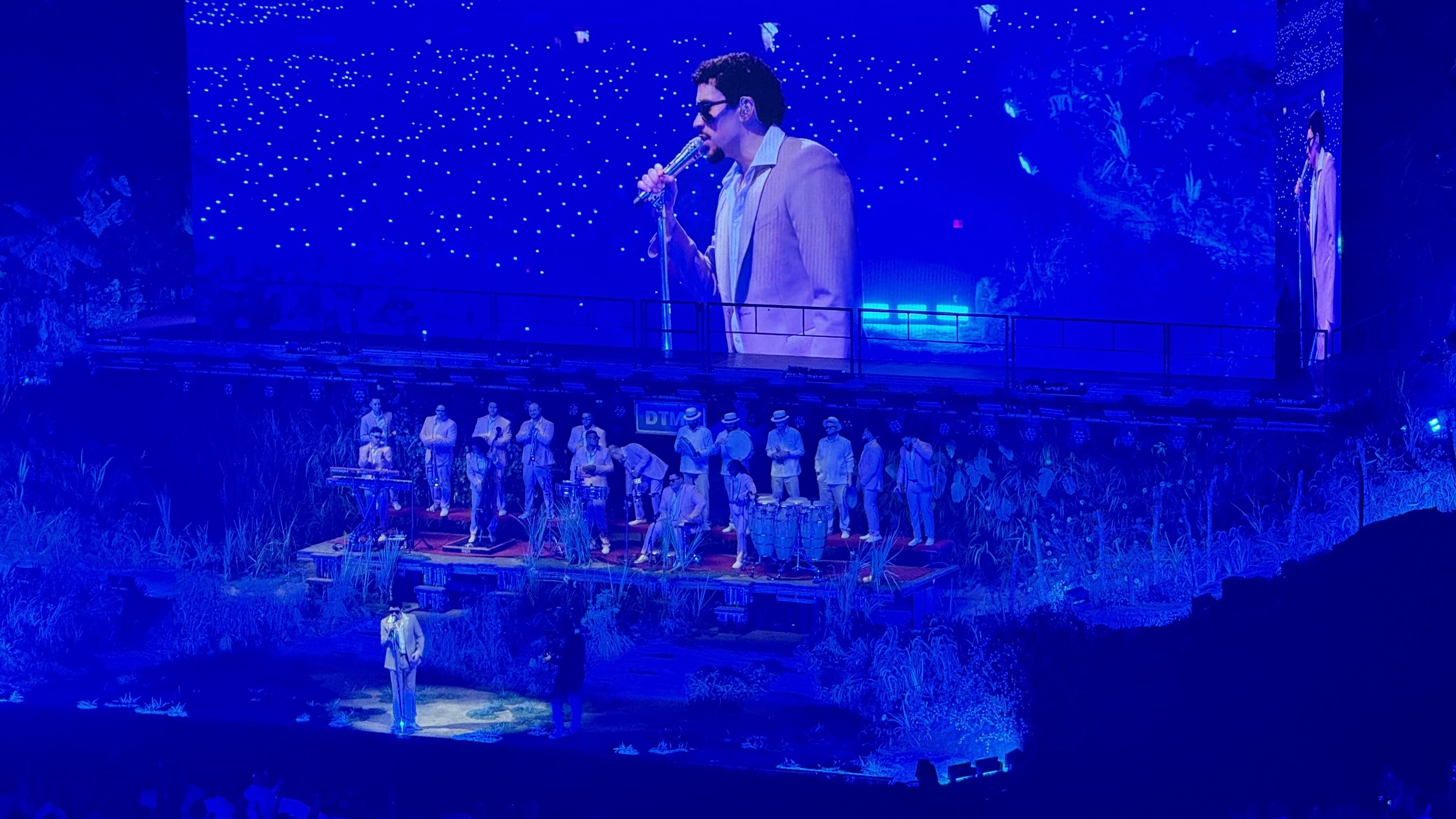
Image courtesy of Comecoquito via Wikimedia Commons, ©2025. Some rights reserved.
The views and opinions expressed in this article are those of the author and do not necessarily reflect those of the wider St Andrews Foreign Affairs Review team.