AI in Warfare: The Strategic Risks Behind the Military Advantages
In 2017, Russian President Vladimir Putin declared that 'whoever becomes the leader in this sphere will become the ruler of the world'. He was talking about artificial intelligence (AI). Armies are now heavily investing in AI. For instance, the US Department of Defense’s unclassified AI investment roughly tripled, from just over $600 million (£450 million) in 2016 to about $1.8 billion (£1.3 billion) in 2024, with more than 685 active AI projects being developed.
This trend is not only a US phenomenon; it has been observed in institutions and armies of other major powers, including Russia, which planned to automate 30% of its military equipment by 2025, and the European Defence Fund, which allocates 4% to 8% of its yearly budget to emerging disruptive technologies, including AI. These investments go towards AI-enabled systems, making it possible for the military to conduct image recognition to identify objects but also humans, with systems extending to facial recognition and facial expressions, allowing for both biometric identification and emotional analysis. AI-enabled systems also help with text analysis, from translation to sentiment analysis.
More recently, AI has taken a bigger role in the military and is now able to select and engage targets autonomously. These systems are called Lethal Autonomous Weapon Systems (LAWS). As AI-enabled weapons emerge in recent conflicts, such as Israel’s use of the 'Gospel' targeting system in Gaza or AI-guided drones in Ukraine, the United Nations continues to urge their prohibition under international law, and stresses that the use of such systems is 'politically unacceptable and morally repugnant'.
Despite the ethical implications, the adoption of AI-enabled systems presents various advantages for militaries. The first advantage is the speed of decision-making, increasing the speed of certain armed forces to collect all the factors necessary to make decisions, allowing them to make quick decisions, sometimes ahead of adversaries. However, this advantage should not be overstated, as operations are often slowed down by the time needed to move troops and equipment rather than by decision-making itself.
Another key aspect is the use of Big Data: data sets that are so large, complex, and fast-growing that traditional software cannot store, manage, or analyse them. These include information gathered on the battlefield, satellites, surveillance drones, and so on. Using AI to analyse this information is incredibly useful because it saves analysts time, and helps them make sense of complex information.
AI also offers improved targeting and vision. With the increasing presence of cameras globally, there is a need for the capability to analyse footage and images quickly. AI systems can analyse them more rapidly than humans, and are able to identify elements that they might miss. With the facial and behavioural recognition mentioned in the introduction, AI systems are able to identify potential suspects or targets sooner, allowing for a quicker response time from decision-makers.
This leads to the advantage of decision-making support. With all the data accessed by AI-enabled systems, recommendations can be made in less time and can, in some cases, be superior to the regular decisions provided by humans. Another positive aspect is that it reduces casualties, as well as manpower issues. Indeed, AI-enabled systems can replace humans for some specific tasks, which can reduce the risk of manpower shortages, as well as deaths in hazardous areas.
Finally, AI brings improvements in accuracy and precision, as machines are not subject to tiredness or loss of focus and tend to be more accurate and very precise. For example, humans tend to roughly estimate or round numbers, whereas an AI system will give the most precise number possible. However, a precise answer is not necessarily a correct one.
While the use of AI-enabled systems offers great operational advantages, their use is also associated with significant risks. As AI systems are largely trained on historical data, they can reflect existing biases. For example, by analysing suspect behaviours and individuals through camera footage, an AI system might target a particular race, gender, or class.
The second issue is the black-box issue, which occurs when humans cannot comprehend how AI reaches the answers it provides. There are three reasons for this issue, and military AI is likely affected by all three: actors hide the reasoning process on purpose, people do not have the technical knowledge to understand the process, and AI 'thinks' in a way humans cannot follow. This results in a major issue regarding accountability, as humans cannot explain why a system picked a specific target, for instance. It also makes it difficult for the commanders to verify whether an attack respects international humanitarian law, which requires them to distinguish between civilians and combatants.
AI systems are also subject to hallucinations: 'confident assertions of information that is factually incorrect, misleading, or entirely fabricated'. For example, an AI system could be analysing drone images and interpret a shovel as a weapon, flagging a civilian home as a military target. This is particularly dangerous because, unlike a visible malfunction, a hallucination can pass through the decision-making process unnoticed.
Another risk associated with the use of AI in warfare is that it could cause arms racing or escalation. The current race between Russia, China and the US in pursuit of military AI to gain an advantage in warfare could result in a proliferation of AI-enabled weapons. This race also creates an incentive to deploy systems quickly, without sufficient attention to their safety and reliability.
Furthermore, autonomous weapons might not be sensitive enough to political considerations or escalation thresholds. As a result, they might attack in places or with levels of intensity that could quickly escalate a conflict. Accountability is also a problem here, as it is difficult to determine if human operators should be held accountable for an escalation committed by AI. Commanders could also take greater risks based on AI recommendations, as these systems do not weigh the value of human lives the way a human would.
The last concern, which applies not only to the military but to any area using AI, is the overreliance on its outputs. Due to its complexity, people might tend to accept its outputs without question, which is called 'automation bias'. This makes the previous risks even more dangerous, as biased or hallucinated outputs are less likely to be questioned.
Armies therefore face a choice between strategic advantage and ethical considerations: to either keep up with adversaries or be penalised for the sake of morality. Yet the risks associated with AI on the battlefield are too serious to leave this choice to each army alone, which shows the urgency of regulating the use of AI in the military under international law. It is also critical to determine the degree of human intervention required for each system and each phase of its use.
The question arises whether humans should be kept in-the-loop (approving each action), on-the-loop (supervising with the ability to intervene), or completely out-of-the-loop (no human involvement). While these questions are being brought up on the international scene, technology continues to develop, and a concern arises: will international institutions be able to regulate its use before new LAWS and other advancements emerge?
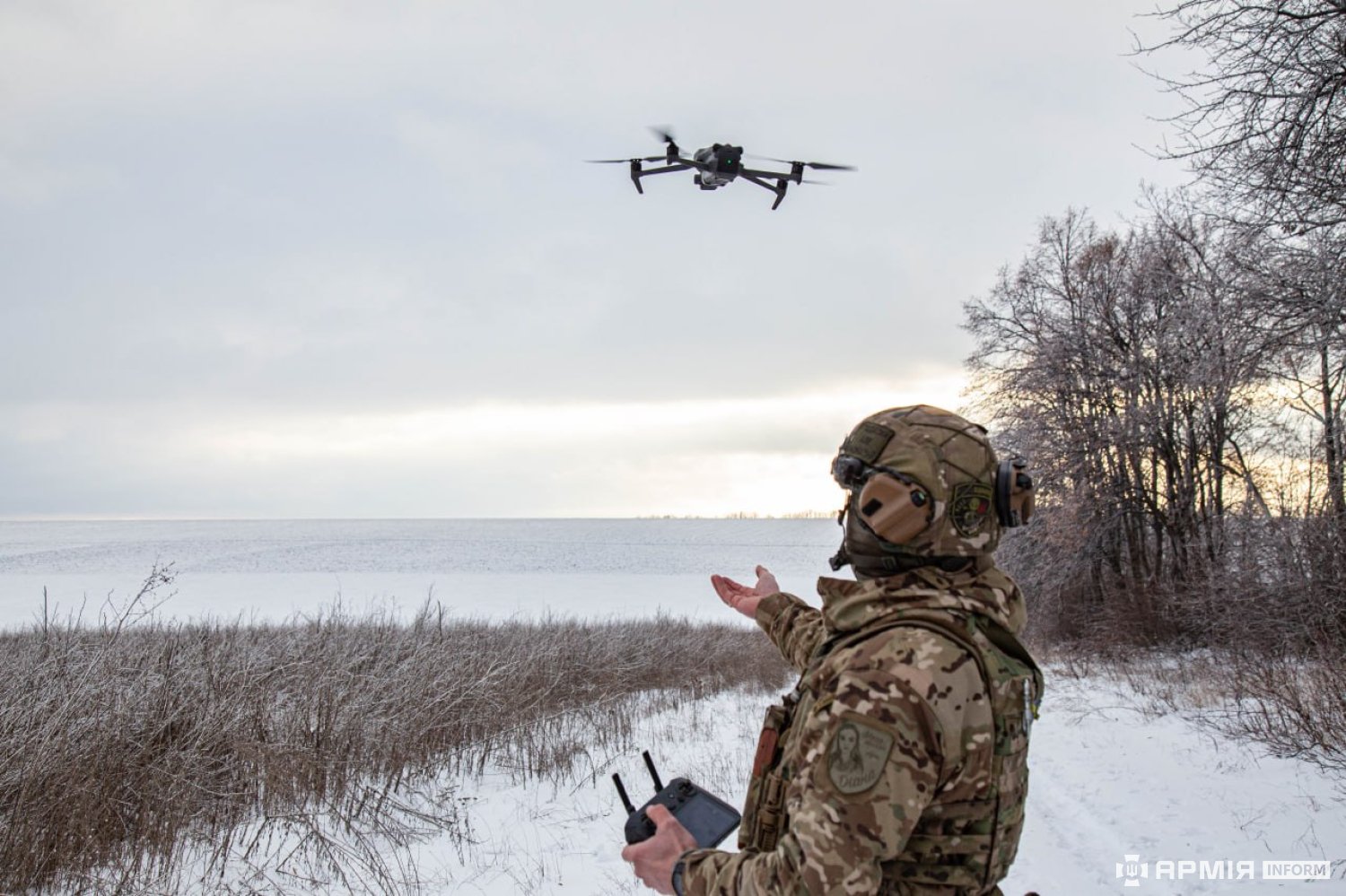
Image courtesy of ArmyInform via Wikimedia Commons, ©2024. Some rights reserved.
The views and opinions expressed in this article are those of the author and do not necessarily reflect those of the wider St Andrews Foreign Affairs Review team.