One Blockade, Four Legal Stories: What Washington’s War on Iran Reveals about International Law
One Sunday in April, a US destroyer in the Arabian Sea spent six hours ordering an Iranian-flagged cargo ship, the Touska, to stop. When it did not, according to the US account, the destroyer fired into the ship’s engine room and American forces seized it. Tehran called the attack a violation of the temporary ceasefire between the two countries. Jennifer Parker, a naval expert, reached a different conclusion: the strike was consistent with the law of naval warfare, the part of the laws of war that governs conflict at sea.
Both claims are defensible, and that is the problem. The Touska was disabled by a lawful act of war, during a ceasefire, in a war that more than 100 international law experts say should never have begun. Whether Washington’s blockade of Iran is legal depends on which legal question one chooses to ask, and the United States has repeatedly framed its actions in ways that change that question.
Four Frameworks, One Campaign
The legal story began on 28 February, when the United States and Israel launched strikes on Iran. UN Secretary-General António Guterres condemned the use of force the same day, reminding member states that the UN Charter prohibits force against the territorial integrity or political independence of another state.
Ten days later, Washington set out its defence in a letter to the Security Council. The strikes, it argued, were ‘necessary and proportionate actions in exercise of the inherent right of self-defense' under Article 51 of the Charter. Any assessment of the threat, the letter added, must account for Iran’s ‘decades of consistently malign foreign and domestic conduct’. Critics noticed what that conduct included. The New York City Bar Association pointed out that the letter relied on the 1979 hostage crisis, the 1983 Marine barracks bombing in Beirut and the 1996 Khobar Towers attack, none of which could show that an attack was imminent in 2026.
By April, the justification had changed. A statement from the State Department’s Office of the Legal Adviser described the operation, named Epic Fury, as ‘only the latest round of an ongoing international armed conflict with Iran’. It also stated plainly that the United States ‘does not rely on a theory of imminence’ to justify its actions.
That move, from defending against a threat to continuing a war that never ended, is more than a shift in wording. A claim of self-defence requires a state to show that force is necessary to meet a threat. A war that never ended requires no such showing: in an ongoing conflict, according to the same statement, there is ‘no requirement to continually reassess’ necessity and proportionality. Washington had moved its argument from one body of law to another, and in doing so escaped the test it was struggling to pass.
The same reasoning carried the blockade. When peace talks in Islamabad collapsed in April, during a two-week ceasefire, the United States announced it would blockade Iran’s ports. Defenders such as James Kraska of the US Naval War College argue that a blockade is a ‘lawful measure during armed conflict’. Yet a ceasefire was supposedly in force. Iran’s Islamic Revolutionary Guard Corps (IRGC) warned that any approaching US warships would breach it, and Nicole Grajewski of Sciences Po described the blockade as an effective resumption of war.
Here the State Department’s argument quietly does a second job. It had insisted that the pause after the US strikes of June 2025 was merely a ceasefire, lacking the permanence and stability needed to end a conflict. If a ceasefire does not end a war, then a blockade during one is simply part of that war. The logic that spared Washington from justifying the February strikes anew also allowed it to blockade Iran while claiming to observe a truce. Self-defence, a continuing war, a lawful blockade and a ceasefire: four descriptions, each answering a different objection, all applied to a single campaign.
Where the Law Bites
None of this means international law has been irrelevant. When he announced the blockade, President Donald Trump vowed to stop ‘any and all Ships from trying to enter, or leave’ the Strait of Hormuz. Within hours, US Central Command (CENTCOM) narrowed the order. The blockade would apply only to vessels entering or leaving Iranian ports, would be enforced ‘impartially against vessels of all nations’ and would ‘not impede freedom of navigation’ for ships travelling anywhere else.
The distinction is not cosmetic. As Parker explains, blockading the strait itself would be unlawful, because it would cut off neutral ports across the Persian Gulf whose ships enjoy a right of passage. A lawful blockade must also be declared, applied to all ships alike, allow humanitarian goods through and be effectively enforced.
CENTCOM’s announcement reads like a checklist of those requirements. Even the treatment of the Touska, with hours of warnings before shots aimed at its engine room, followed the sequence the law of naval warfare permits.
The law, in other words, shaped the operation. It decided where US ships could stop vessels, which vessels they could stop and how. What it did not decide was whether the United States could squeeze Iran at all.
The Guardian Angel of the Strait
Yet the line between Iranian ports and the strait, the clearest sign of the law’s influence, lasted only a few months. An interim agreement signed in June was meant to reopen the strait and halt hostilities while talks continued. By mid-July it had collapsed, and Trump announced that he was ‘reinstating THE IRANIAN BLOCKADE’. This time the careful legal language was gone. The strait would stay open ‘with or without Iran’, Trump said, and the United States would most likely play the role of ‘guardian angel’ of the Strait of Hormuz. President Trump also said the US would demand a 20% reimbursement on all cargo shipped through the strait.
The irony is hard to miss. Iran had been charging some ships millions of dollars to pass through Hormuz, and Trump himself had said that Iran must not be allowed to profit from controlling the waterway. A US charge on all cargo through the strait would raise the same objection. It is not clear if the proposal was ever put into practice. But the statement alone shows how thin the April constraint was. Nothing outside Washington had forced CENTCOM to limit the blockade to Iranian ports; the US had chosen to frame the operation in the language of the law of blockade. Once the President stopped using that language, the limit had nothing left to hold it in place.
Tehran’s Own Legal Story
None of this excuses Tehran. Since the war began, Iran has choked traffic through the Strait of Hormuz, and its forces have fired on neutral merchant ships, including an Indian tanker that had been approved to pass. Parker concludes that these ships were not lawful military targets. Kraska notes that the International Court of Justice ruled as early as 1949, in the Corfu Channel case, that coastal states may not block waterways used for international shipping. Iran has its own preferred legal story too, calling the US blockade ‘piracy’ while asserting control over a strait that neutral ships are entitled to pass through.
The difference lies in who can make the story stick. Any state can claim a convenient legal framework; few can enforce one. Iran’s attacks on neutral shipping are widely regarded as unlawful. The US blockade, despite criticism from China and from allies such as Spain, has been backed by a navy that turned away at least 23 ships in its first week. When the main contest is over how conduct is described, the state with the strongest navy is usually the one whose description wins.
Shaping Power, Not Stopping It
The blockade is usually debated as a yes-or-no question: is it legal? The most revealing answer is that Washington has ensured there is no single question to answer. Each objection, whether about imminence, the ceasefire or the blockade’s scope, has been met by moving to a body of law where that objection no longer applies.
International law has not been powerless. It turned a threatened blockade of a strait into a blockade of ports, and it dictated how ships were warned and stopped. For crews of neutral ships crossing Hormuz, those effects matter a great deal. But they are effects on the form of US power, not on its use. The law decided how Iran would be squeezed, not whether.
At Nuremberg, the chief American prosecutor, Justice Robert Jackson, observed that international law ‘throws a mantle of protection around acts which otherwise would be crimes, when committed in pursuit of legitimate warfare’. The Iran blockade suggests that, for a powerful state, the question may no longer be whether its actions meet the law’s standards, but by which standards it is judged.
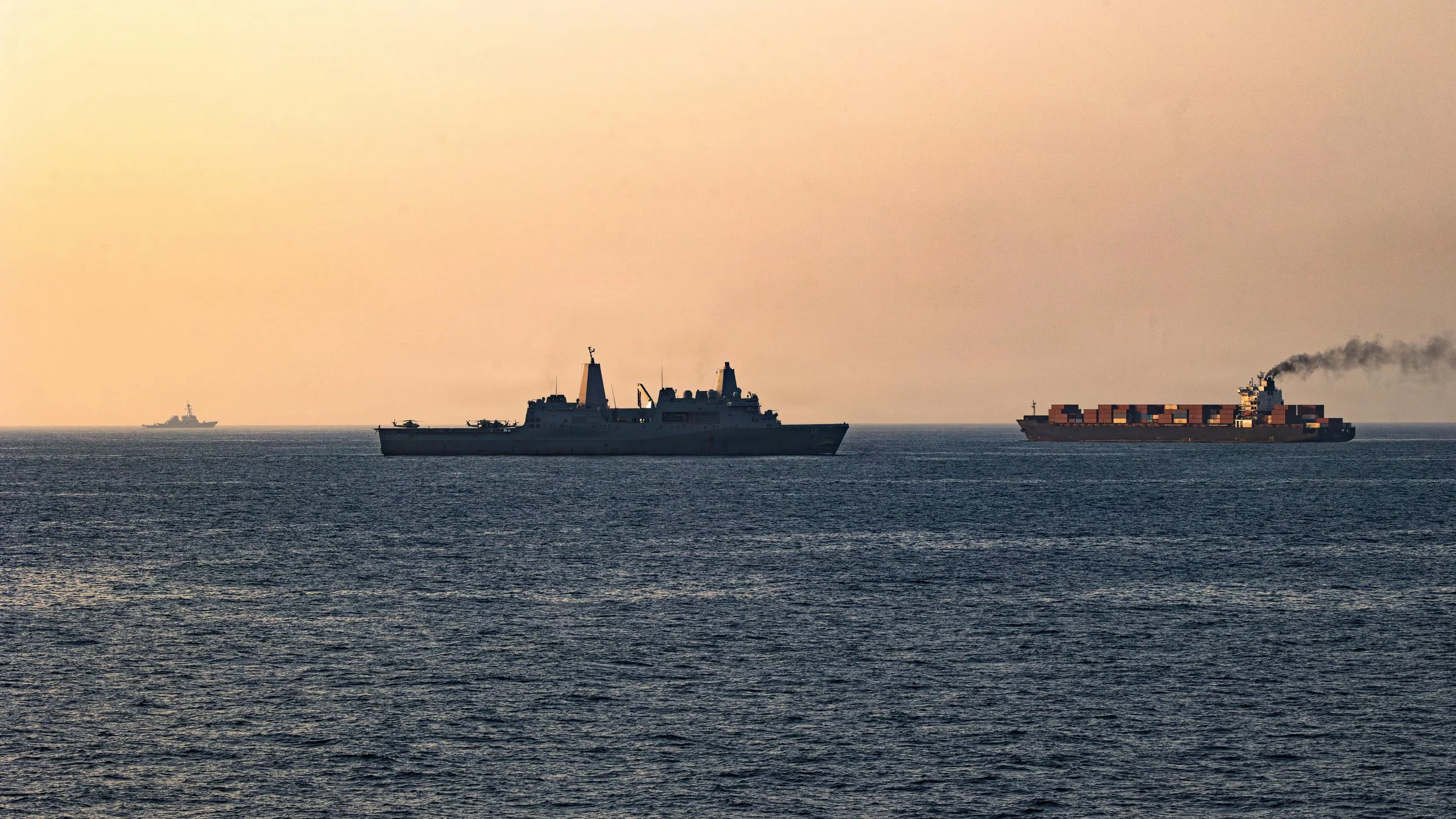
Image courtesy of United States Marine Corps via Wikimedia Commons, ©2026. Some rights reserved.
The views and opinions expressed in this article are those of the author and do not necessarily reflect those of the wider St Andrews Foreign Affairs Review team.
