Sánchez and Spain’s Quiet Drift from U.S. Hegemony
Pedro Sánchez assumed the presidency of the Spanish Government in 2018, bringing the Spanish Socialist Workers' Party (PSOE) to power through a vote of no-confidence to Mariano Rajoy, leader of the Popular Party (PP). Since then, Sánchez’s government has become one of the most openly confrontational voices in Europe against Washington. This drift away from U.S. hegemony is the product of ideology, domestic politics and a calculated bet on multilateralism over unipolarity aligning with a coherent vision of international law and multilateral order.
Economic security against the US?
Since the COVID-19 pandemic, Spain has seen robust economic growth, outperforming the eurozone average. In 2025, the Spanish economy grew by 2.8%, a significant number compared to the 1.5% growth average in the eurozone. This has been driven by the expansion of a record-breaking labour market, with unemployment going below 10%, a feat not achieved since 2008.
Since the start of the Trump presidency, US tariffs have been of significant concern with opposing countries such as Brazil and South Africa facing direct backlash from this policy. Spain, on the other hand, shares its trade policy with the European Union. This has raised questions about whether Spain has the economic backing to oppose US foreign policy.
Nevertheless, the EU's collective trade framework has functioned as a geopolitical buffer, enabling Madrid's defiance in a way that smaller, non-EU states simply cannot afford. Additionally, the US has had a trade surplus with Spain for the fourth year in a row in 2025, at $4.8 billion, making Spain less vulnerable to Trump’s threats than other nations.
Overall, this has allowed Spain to respond to US threats effectively, Pedro Sánchez himself asserting that the country has the necessary resources to face a possible trade embargo from the US.
Moral drift in the Israel-Palestine conflict
Nowhere has Sánchez broken more sharply from the Washington consensus than on the Israeli-Palestinian conflict. By recognising the Palestinian state in 2024, Sánchez started a trend within European nations with France following in 2025. Additionally, Sánchez has described the conflict as a “genocide”, breaking away from the US position. Spain took more definitive actions against the US-backed Israel-Gaza war with its intervention in the South African genocide case against Israel before the International Court of Justice. The same case that the US intervened in, describing the accusations as a “broader campaign” against Israel and the Jewish people “to justify or encourage terrorism against them.” This clearly highlights the disconnect between Spanish foreign policy alignments with the US. This is further reinforced as the Spanish government reportedly blocked American-flagged ships from using its ports because it believed the vessels were carrying military equipment to Israel. These moves have made Sánchez a leading voice of the European opposition to the war and a persistent counter to Washington and Jerusalem alike.
Venezuelan conflict
Since then, Sánchez’s government has continued to criticise military actions by the US on the basis of its lack of accordance with international law. The Spanish government’s reaction to the operation carried out by the US in Venezuela in January 2026 encapsulates the current drift away from US influence. The military strikes and the capturing of the President Nicolás Maduro was condemned by Sánchez, asserting that while the government of Spain does not recognize Maduro’s regime, the US’s actions are a violation of international law and risk pushing the region towards further uncertainty and instability. This was not a defense of the regime as the Spanish government did not recognize electoral results in the Venezuelan election of 2024, but rather a defence of the idea that regime change through military force sets a dangerous precedent.
Iran war
Following the Venezuelan operation, Trump launched a full-scale attack called Operation Fury against the Government of the Islamic Republic of Iran, killing its supreme leader Ali Khamenei. The Spanish government closed its sovereign airspace and denied access to military bases for any US aircraft used to strike Iran. This was the clearest indication of a rupture between Spain and the US, the bases of Rota and Morón being strategically decisive to US operations. Trump denounced this ban and called it “terrible” while Sánchez himself proclaimed “No to war”. He drew direct comparison to 2003, where Spanish involvement in the US-led war in the Middle East led to a drastic increase in terrorism, a migration crisis, and an increase in energy prices. Spain’s decision to not partake but also to prevent actions involving the use of Spanish bases highlighted a shift towards a more autonomous and law-based foreign policy stance.
To conclude, as of 2025, 10% of Spanish citizens saw the US as an ally to the EU, this public opinion has been directly reflected in Pedro Sánchez’s foreign policy. While his approach is not risk free, Sánchez is becoming the figurehead of a wider desire to shift away from US dependence and actions in the EU. Through repeated actions against US-led operations and wars, has positioned Spain as the EU’s most audible dissident voice in a post-American order, signalling that transatlantic loyalty may be eroding.
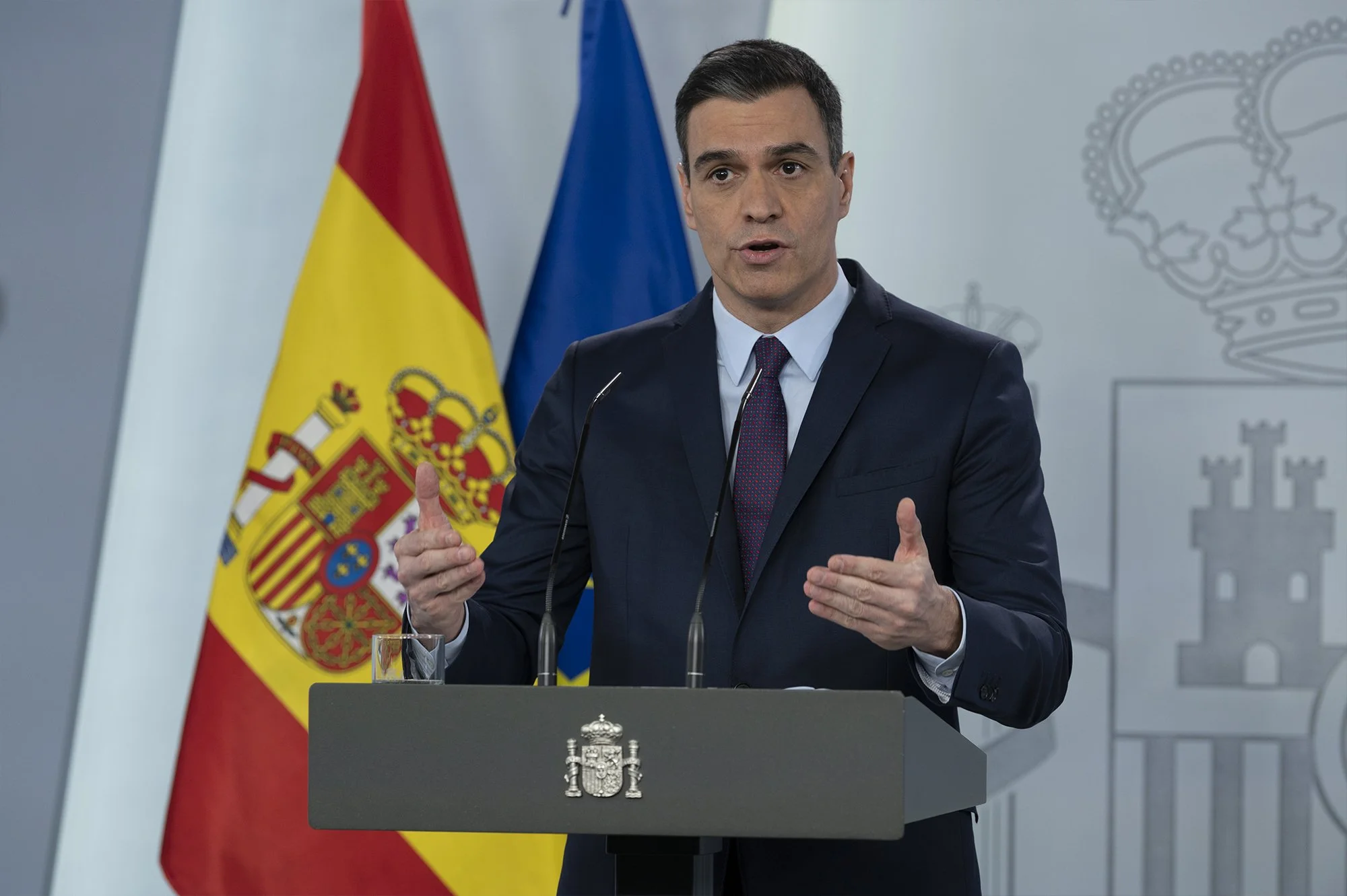
Image courtesy of La Moncloa - Gobierno de España via Flickr, ©2020. Some rights reserved.
The views and opinions expressed in this article are those of the author and do not necessarily reflect those of the wider St Andrews Foreign Affairs Review team.