Hollowed Out: How Corruption and Party Political Struggles Erode Mongolia’s Government
On 31 March, Mongolia inaugurated Nyam-Osor Uchral as its new Prime Minister. Usually, the selection of a new prime minister would not be anything particularly out of the ordinary. However, Uchral is Mongolia’s third prime minister in less than a year. This, and the context surrounding and preceding Uchral’s rise, highlights Mongolia’s political and democratic decline.
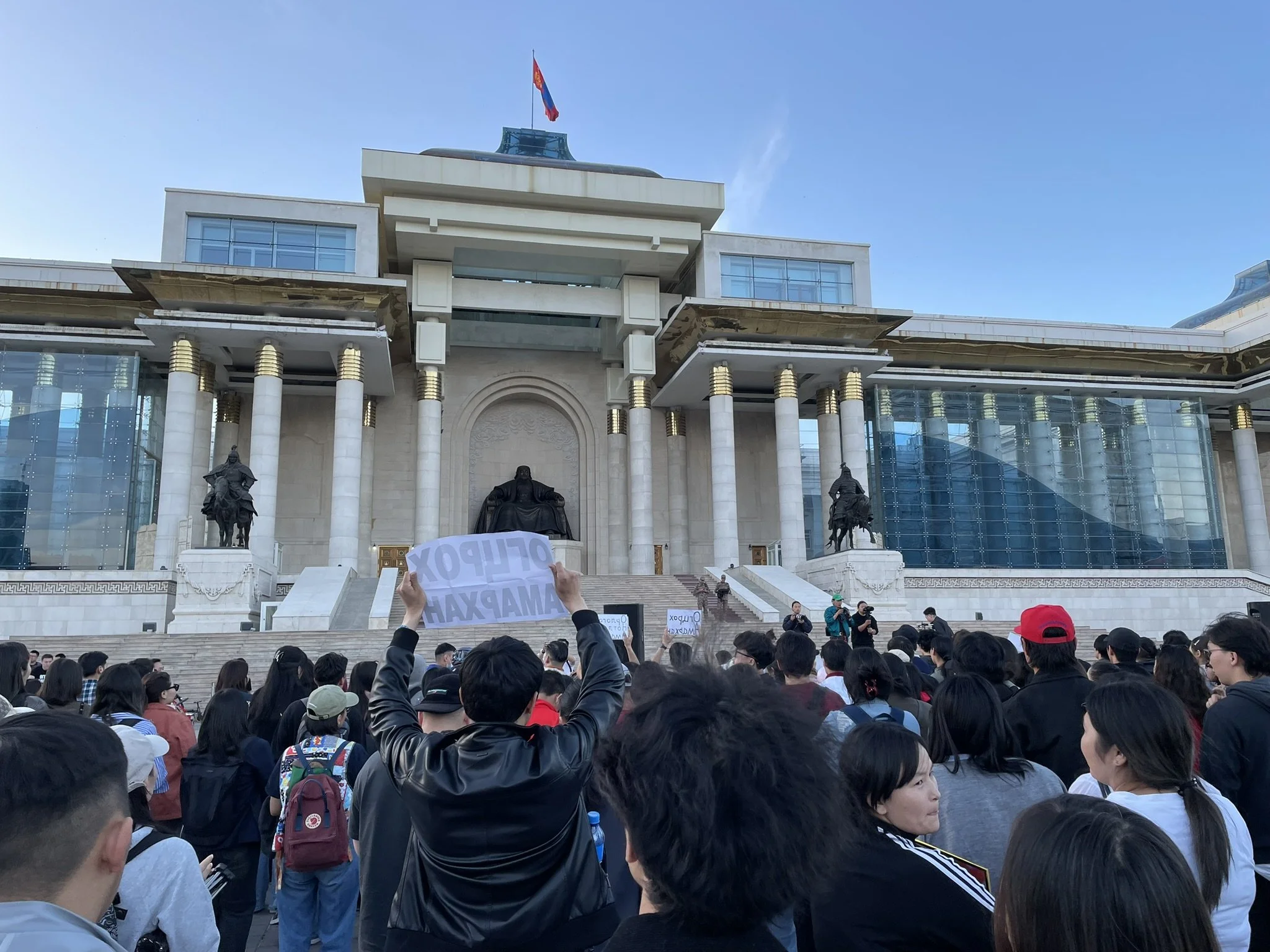
Mongolian politics has long been embroiled in corruption and political infighting. The most recent events were prompted by widespread protests in May 2025, during which the then-Prime Minister Luvsannamsrain Oyun-Erdene was accused of corruption. This came after reports revealed that his son was giving his fiancée lavish gifts, raising questions about the family’s finances. The 2025 protests called for Oyun-Erdene's resignation, before expanding to wider anti-government demands. In particular, the protests focused on widespread elite corruption and wealth inequality. These protests led to Oyun-Erdene resigning as Prime Minister on 3 June, 2025. These are not the first anti-government protests in the country since it suffers from deeply entrenched corruption, particularly among government officials and natural resource projects. Public discontent is understandable in Mongolia as a quarter of the population lives in poverty, despite the country’s large quantity of natural resources.
Beyond the protests, Oyun-Erdene was also pressured by deep divisions within his own Mongolian People’s Party (MPP), which has governed since 2016. Within the MPP, there is an ongoing internal power struggle between a reformist faction loyal to Oyun-Erdene and a conservative faction, loyal to the current President Ukhnaa Khurelsukh. These camps jostle for control over the country’s two highest offices, the Prime Ministership and the Presidency, the latter of which is up for election in 2027.
Following Uchral’s resignation, President Khurelsukh appointed his ally, Gombojavyn Zandanshatar, as Prime Minister. He was then confirmed by the State Great Khural, the Mongolian Parliament. This sparked the other component of Mongolia’s power struggle, one within the MPP itself. The Party Chairmanship election pitted conservative Zandanshatar against reformist Dashzegviin Amarbayasgalan, an ally of Oyun-Erdene and then-Chairman of the State Great Khural. Amarbayasgalan won the race, but the legitimacy of his victory was contested, further exacerbating political divides. At the same time, members of the other faction accused Amarbayasgalan and other politicians of complicity in a coal theft scandal, further complicating the situation. In an attempt to elect a chair amenable to both factions, the MPP then elected Nyam-Osor Uchral as Party Chairman as a compromise. He would also be elected as Speaker after Amarbayasgalan was eventually ousted.
While Zandanshatar was not elected Party Chair, he remains Prime Minister despite the precedence of both positions being held simultaneously. A few months later, the State Great Khural convened in October 2025 to vote on removing Zandanshatar as Prime Minister, a process presided over by Deputy Chairwoman Khurelbaatar Bulgantuya. The assembled parliamentarians voted to remove Zandanshatar. President Khurelsukh then vetoed this dismissal, citing irregularities in the voting procedures, and then appealed to the Constitutional Court of Mongolia. After review, the constitutional court decided that the parliamentary vote to remove Zandanshatar was illegal and vacated the vote. Zandanshatar’s premiership was preserved, and the Deputy Chairwoman was indicted for ‘an organised effort to unlawfully seize or retain state power’. Essentially, Bulgantuya was charged with plotting a coup. Bulgantuya seems to be targeted by the state apparatus for moving against Zandanshatar and one faction of the MPP. This series of events shows that Mongolia is in both a democratic and institutional breakdown, where state power is used against political opponents and disputes within the Mongolian People’s Party add fuel to the fire.
Zandanshatar's premiership was once again threatened in March 2026 when Parliament failed to establish a quorum because the opposition Democratic Party (DP) boycotted Parliament in response to the concentration of power within the MPP government. The DP wanted Uchral’s resignation, who was, at this point, both Chairman of the State Great Khural and of the MPP. Further, Oyun-Eredene’s faction of the MPP disrupted the session, causing Parliament to grind to a halt. Parliamentary infighting, combined with corruption allegations against a senior minister, led Zandanshatar to resign on 27 March, 2026. In his resignation speech, Zandanshatar stated he resigned to resolve the political crisis and defended his government’s record.
Uchral replaced Zandanshatar as Prime Minister on 31 March as another compromise between MPP factions. In his inaugural speech, Uchral decried the current political deadlock, vowing to overcome his own party’s divisions. Previously, as Chairman of the MPP, he expelled multiple party members, including Amarbayasgalan and Bulgantuya, to combat corruption. It waits to be seen, however, whether Uchral’s premiership will truly turn the page for Mongolian politics as he seems already inextricably involved in MPP infighting, or whether he too will become embroiled in a corruption scandal.
While Uchral may offer a reprieve from this current political crisis, the structural issues plaguing Mongolian politics and democracy will only escalate. Parliamentarians themselves have stated how the work of governing the country has essentially ground to a halt due to rolling political crises and politicians’ self-interest. Moreover, corruption by elected officials has collapsed public trust in government, with politicians beholden to corporate interests or societal elites rather than the Mongolian electorate. Simultaneously, Mongolia’s democratic institutions are increasingly under strain and manipulated by the government to serve its own political ends, with democracy indexes suggesting that Mongolia is autocratizing. This begs the question of whether further institutional and political decline will inevitably lead to autocracy.
While the current situation appears dire, Mongolia has beaten the odds before. After Mongolia’s democratic revolution, a vibrant democratic society formed when many similar states descended rapidly into authoritarianism. The country has a strong civil society that works to keep the government accountable and is indispensable in reversing the current decline. This provides hope for a better Mongolia that transcends entrenched political corruption, institutional decay, and paralyzing political infighting. The future of the country is in the hands of the Mongolian people, who have long fought for change. The international community should not ignore the situation in Mongolia and instead support the Mongolian people as they strive for a better tomorrow.
Image courtesy of Mooonswimmer via Wikimedia Commons, ©2025. Some rights reserved.
The views and opinions expressed in this article are those of the author and do not necessarily reflect those of the wider St Andrews Foreign Affairs Review team.