Ten Years Since the Calais ‘Jungle’: Human Rights on the Backburner
“Everyone has the right to seek and to enjoy in other countries asylum from persecution.”Art. 14 of the UN Universal Declaration of Human Rights (UDHR)Monday 24th October 2016. More than 1200 police officers are deployed to begin the official closure procedures of the Calais ‘Jungle’ refugee camp; half of the zone’s population is forcibly removed by French authorities, the other half flees.
Tuesday morning. Bulldozing and excavating begins.
Wednesday. Flames have engulfed the site. There is little left but smoke.
The ‘Jungle’, as it was commonly called, was a refugee camp on the outskirts of Calais, northern France. Located just west of the country’s largest port for passenger traffic and less than 30 miles south of Dover, it had grown to become home, albeit a temporary one, to an estimated 10,000 refugees aiming to cross the Channel in the hopes of claiming asylum in the United Kingdom.
Close to a decade later, there are still a fluctuating 1500-2000 refugees in and around the Calais-Dunkirk area. Young men, women and children, most of them from Afghanistan, Syria, Iran, Sudan and Eritrea, find themselves funnelled to this very corner of France after months if not years of displacement.
The conditions are dire. With no access to drinking water, sanitation, energy, food, clothes or shelter they are completely reliant on the work of both British and French charities on the ground such as Care4Calais, Refugee Community Kitchen and Utopia 56, many of which were created in 2015 as a response to the lack of government-led humanitarian relief initiatives. They carry out vital work not only to provide those displaced with food, clothes, tents and other necessities, but also to document and denounce human rights violations committed by the local and national authorities, particularly police violence.
“Everyone has the right to a standard of living adequate for the health and well-being of himself and of his family” Art. 25.1 UDHR 2015
In 2015, in an article for Al Jazeera, Jean Carrere followed the lives of two young men in Calais over the course of several months, at times living in the camp himself. Even back then, he recounts the severity of the French police operations:
“Starting at 5am, the local police force rounded up the occupants – mostly recently arrived Syrian refugees – of all the camps in the city and around the port and marched them to the Jungle. […] The main entrance to the camp passes under a highway leading into the city. There are no written rules about where the camp’s residents should stay, but a decision had apparently been made that the large dump where the Jungle thrived ended at that bridge. […] the riot force that had marched the refugees into the camp stood in line at the bridge, and told all those living beyond it to move. Only they wouldn’t let them take any of their belongings with them. Refugees and volunteers alike pleaded to be allowed an hour to take the tents inside the camp, but the orders were clear and the line stood firm. A bulldozer was called, and all the tents from the bridge onwards were destroyed.”
In August of that same year, then British Home Secretary Teresa May and France’s Interior Minister Bernard Cazeneuve signed a multi-million-pound agreement to tighten border security measures, fight human trafficking, deter ‘illegal’ immigration and facilitate the removal of those already in the UK. Across the 28-point file, only one mentioned the direct protection of those in camps. Even then, these concerns only vaguely applied to the ‘most vulnerable’, of which the only detail mentioned being women and children. Not a single point signalled towards efforts from either the French or British authorities to assure the total compliance with and active implementation of either the 1951 Refugee Convention and its 1967 Protocol or the 1948 Universal Declaration of Human Rights, the latter ironically adopted in Paris, a mere 150 miles south of Calais.
“No one shall be subjected to arbitrary arrest, detention or exile.” Art. 9 UDHR“No one shall be arbitrarily deprived of his property.” Art. 17.2 UDHR 2025
10 years on, and the situation is at a standstill, if not a landslide. In September 2024, several French Members of Parliament put forward a resolution proposition concerning the creation of a survey commission regarding the ‘respect of the rights of those in situations of forced displacement’. In the document, both local and national authorities are held accountable for neglecting their responsibilities when it comes to supporting those displaced.
Multiple accounts of Human and Refugee Rights violations are reported, including:
· Violent police intervention on French shores, including the use of teargas and the laceration and sinking of small boats, directly endangering the lives of those on board.
· The inconsistent implementation of post-wreckage and drowning protocol by the local council, such as the provision of heated tents, dry clothes and a safe place to sleep.
· The lack of psychological assistance for those in Calais; this includes the case of the death of a 7-year-old child on the 3rd of March 2024, where no psychological support was offered to the family affected, which included both parents as well as three siblings under the age of 13 who had all witnessed the scene.
· The implementation of a ‘zero fixation point strategy’ by French authorities to prevent the creation of a new settlement similar to the ‘Jungle’.
Today, the zero fixation point strategy remains the most visible and the most critical issue in Calais, as it directly affects the daily lives of the refugees in the area.
Through the analysis of a report by Human Rights Watch on ‘Enforced Misery’ in Northern France, we can identify two of the strategy’s principal objectives over the past decade:
1) To carry out daily raids on local encampments, destroying structures, tents and confiscating personal items such as phones, passports and cash in order to prevent mid-to long-term settlement.
2) To intimidate and discourage humanitarian action through bans on food and water distributions in the Calais town centre, the instalment of fences and barriers to prevent direct access to certain camps and force those in need to travel further to receive aid, as well as the improper use of infraction inspections, e.g. vehicle inspections, not to ensure public safety or other legitimate policing purposes but rather to impede on the delivery of humanitarian assistance.
“No one shall be subjected to torture or to cruel, inhuman or degrading treatment or punishment.” Art. 5 UDHR“Everyone has the right to life, liberty and the security of person.” Art. 3 UDHR In summary, although now operating on a smaller scale since the destruction of the Calais ‘Jungle’, it is clear the French authorities won’t be stopping their onslaught on refugees and humanitarians alike anytime soon. However, no matter how many millions are spent on the UK and France’s joint efforts to deter and criminalise asylum seeking, when will we learn that no law or limitation will ever justify the blatant disregard for basic Human Rights?
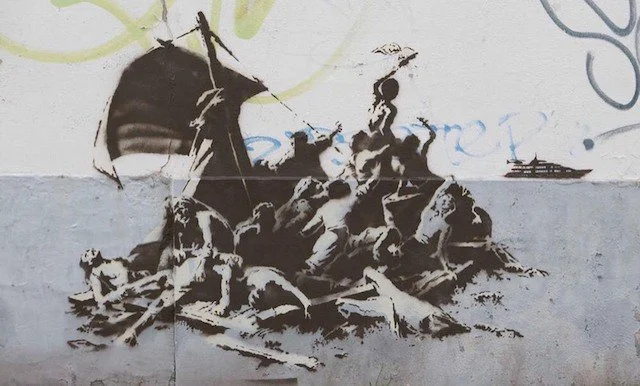
Image courtesy of Banksy via Barbara Picci, © 2015. Some rights reserved.
The views and opinions expressed in this article are those of the author and do not necessarily reflect those of the wider St Andrews Foreign Affairs Review team.