Does a Perfect Democracy Exist? Rethinking the Swiss Political Model
In an age of political polarization and declining trust in democratic processes, Switzerland appears to be an ideal model for highly functional democracies. Commonly referred to as a direct democracy, Switzerland offers unique strategies when assessing the freedom of participation and increasing civilian involvement in political processes. Nevertheless, can any political system, including the Swiss one, truly be considered ‘perfect’?
A ‘perfect’ democracy can be determined through different criteria. A truly democratic state should be able to maximize its representation, accountability, and citizen participation. Additionally, highly democratic states should also uphold transparency, efficiency, and legitimacy.
The Structure of Swiss democracy
The Swiss political model appears to uphold most of these criteria. Switzerland has a consensus-based, federal system in which power is shared among the national government, twenty-six cantons, and local communes. Its direct democracy lets citizens frequently vote on laws and constitutional changes, while a seven-member Federal Council collectively serves as the executive.
This system enables high citizen engagement, as voters directly shape laws and constitutional changes, rendering political decisions more legitimate. This legitimacy is reinforced by the country’s strong federalism. Cantons are empowered to craft policies aimed at resolving and responding to local needs, further reducing polarization and cultivating trust between citizens and institutions. Additionally, Switzerland’s collegial style of government avoids concentrating power in single leaders; instead, this encourages stable, long-term policymaking rather than dramatic ideological swings.
Limitations of the Swiss System
While Switzerland’s political system appears to be idealistic, some limitations may affect due process. The frequency of referendums can delay urgent reforms and lead to compromise-heavy politics, which could water down ambitious reforms.
Additionally, voter turnout is often relatively low for referendums, possibly indicating a degree of political fatigue in Switzerland’s society. For example, the referendum held on 1 February, 2025 on the Environmental Responsibility Initiative was rejected with a voter turnout of 38%. This also might highlight another limitation, with participation being skewed towards older, wealthier, and more educated citizens.
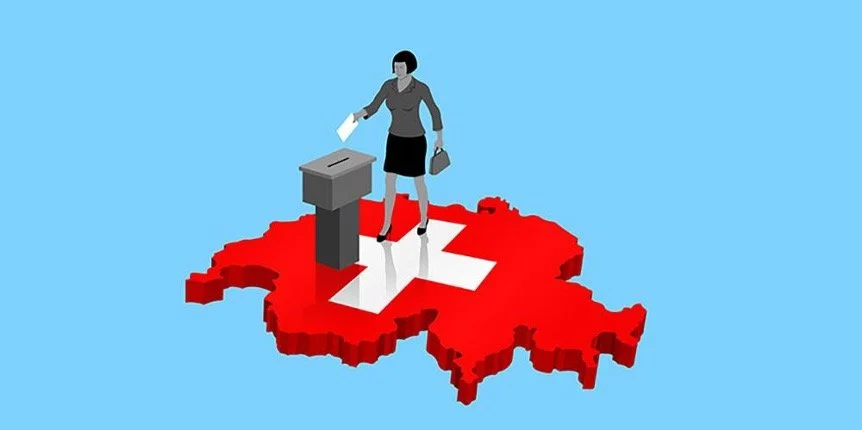
One of the main criticisms, not just of Switzerland’s system but also of the concept of direct democracy, could be the risk of a tyranny of the majority. If the will of the majority allows for the subordination of minorities or the violation of human rights, is it still legitimate and right? This concept has been seen historically with the late enfranchisement of women in 1971. As voting rights had to be approved by male voters nationally, the very group whose power would be diluted had the final say. This created a structural barrier, allowing a majority to block fundamental rights for decades. In this way, direct democracy without adequate constitutional safeguards can risk freezing discriminatory norms.
Can Swiss Democracy Be Exported?
As Switzerland’s democracy is unique to its societal structure, it would prove difficult to export this system elsewhere. A country would need to be territorially small and hold a strong civic culture to be able to replicate Swiss direct democracy. Larger countries would have difficulties with scaling Swiss-style democracy. This could also undermine foreign power for these large countries, making this transition difficult.
To conclude, democracy is a process and not a finished product. Imperfections are therefore inherent to pluralistic societies. Nevertheless, Switzerland offers valuable lessons, and still remains one of the world’s most robust democracies. Rethinking our understanding of democratic perfection may mean embracing complex systems and continuous civic evolution.
Image courtesy of Adobe Stock, © 2016. Some rights reserved.
The views and opinions expressed in this article are those of the author and do not necessarily reflect those of the wider St Andrews Foreign Affairs Review team.