From the Outer Space Treaty to Anti-Satellite Weaponry: International Law Among the Stars
‘We the peoples of the United Nations determined to save succeeding generations from the scourge of war’ ~ Preamble to the United Nations CharterThe idealism espoused in the Preamble of the United Nations Charter, when it was signed in 1945, reflected humanity’s desire for peace after the Second World War. This idealism was tested during the great power competition of the Cold War and in some ways did not survive. However, amidst the turmoil of the Cold War space race between the Soviet Union and the United States, this idealism did shine through. The 1960s and 70s saw the negotiation of several international treaties that formed the foundation for shared practice in space. Today these principles are under strain with the growing number of space-based actors, changing geopolitical priorities, and technological advances.
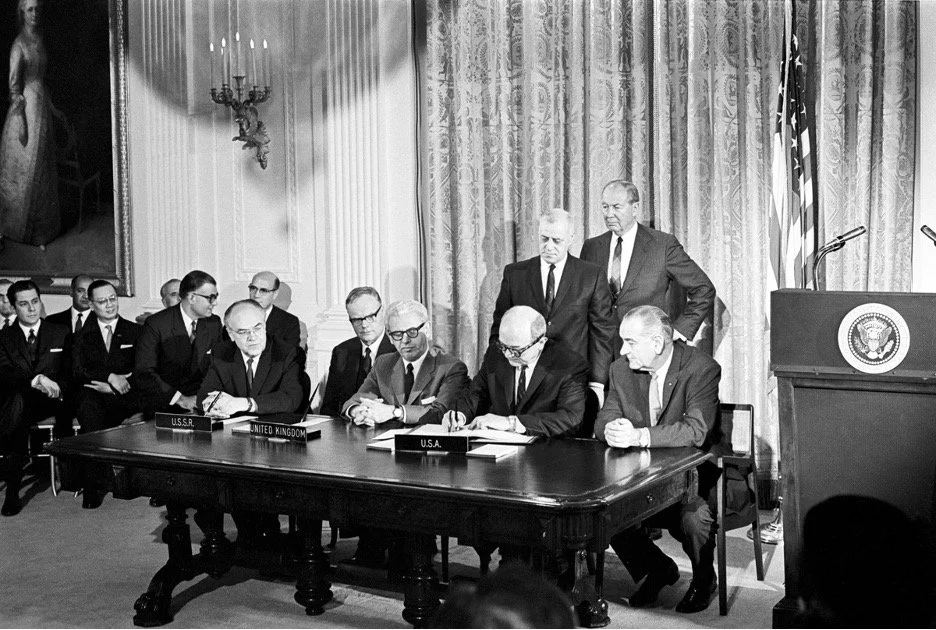
In 1967, the Outer Space Treaty was negotiated, forming the bedrock of space law, and was ratified by all major spacefaring nations. Among its provisions, the Treaty outlawed the stationing of nuclear weapons in space, prohibited nations from claiming sovereignty beyond Earth, and stated that space should be used for peaceful ends for the benefit of all humanity. This sparked several other international agreements and treaties throughout the 1960s and 70s regarding outer space activities: the Rescue Agreement, Liability Convention, Registration Convention, and the Moon Agreement.
At the core of these treaties are the principles of peace and cooperation in outer space where for the last 50 years space has primarily been the realm of scientific exploration. These principles are today under threat; several states are actively participating in a nascent space arms race. China, India, Russia, and the United States have all developed and tested anti-satellite weapons (ASAT). These weapons are designed to disable or destroy orbiting satellites using kinetic or electronic means. The use of ASATs or the wider failure to maintain the outer space environment has the potential to cause a catastrophic event known as Kessler Syndrome. It is theorized that increasing amounts of orbital debris will reach a point where collisions will become inevitable, with each collision increasing the likelihood of another until Earth’s orbit is completely saturated with space debris, rendering space travel impossible. This arms race is already endangering lives. In 2021, Russia tested an ASAT weapon on one of its own satellites, destroying it, but in the process, put the crew aboard the International Space Station at great risk.
This new space age is not only limited to national governments but is increasingly being applied to private corporations. Private companies such as SpaceX, Blue Origin, or Boeing have developed their own independent launch capabilities, with national governments increasingly relying on them for satellite launches, mission payloads, and crew transfers. For-profit companies have very different goals than national governments in space, and their roles and responsibilities are not defined by any existing international agreements, creating a sort of wild west in space for corporate actors. Elon Musk, through his company SpaceX, is planning on going to Mars, raising the question of whether there will soon be corporate colonies on other planets and, more broadly, what role, if any, corporations should play in any future space endeavors.
Since the end of the Cold War, there has been a general norm of cooperation among the major spacefaring powers; however, this has begun to disintegrate. The ISS is nearing the end of its operational life in 2030, and there appear to be no plans to replace it. The project has been a cornerstone of international cooperation for the last two decades, showing how traditional rivals such as the US and Russia can work together despite geopolitical conflicts on the ground. When one of the greatest international scientific endeavors of the century falls back to Earth, it might represent the end of an era of wider cooperation in space. The United States, China, and other nations are all actively seeking to return to the Moon and go on to Mars, to eventually establish long-term human habitation of the bodies. The US-led Artemis Accords have sought to define national practice in space and have been signed by 60 countries. Meanwhile, China and Russia are leading efforts to establish a competing International Lunar Research Station on the Moon, an effort that already has over a dozen participating countries. Both of these efforts are voluntary national initiatives outside the UN, not binding international treaties, further entrenching competing blocs and making cooperation more difficult. Current space law was never written with permanent human settlement in mind and remains wholly unequipped to manage this ever-approaching new reality.
Our current bodies of space law served the world through the chaos of the Cold War, fostering relative peace in space while building the groundwork for future cooperation, but they are no longer fit for purpose. Those days of idealism are passing, and we need to prepare for a future that is fast approaching. The current age of space is coming to an end, but what replaces it is still a choice we must all ask ourselves. Space: the final frontier. Or space: the next battlefield. Do we want to recreate the mistakes of our past, allowing space to become the next arena for colonialism where great powers fight, and humanity suffers the consequences? Do we allow corporations free rein of the stars? Or do we seek to make a better future for ourselves and future generations? Space can continue to be a place where millions look up with wonder and hope for a better tomorrow, or it can be marred in conflict, corporate greed, and despair. Once we begin walking down the path of militarising outer space, we may never be able to turn back.
Image courtesy of the International Telecommunications Union via Wikimedia Commons via Flickr, ©1967. Some rights reserved.
The views and opinions expressed in this article are those of the author and do not necessarily reflect those of the wider St Andrews Foreign Affairs Review team.