When the Trees Fall in Sudan
If a tree falls in a forest, and nobody is around to hear it, does it make a sound?The question is not really about acoustics. It is about existence. About whether an event becomes part of the shared world if there are no witnesses to receive it and carry it into language. Sound without a listener is vibration. Suffering without a witness drifts toward disappearance. What is unwitnessed does not enter memory; it is denied the dignity of acknowledgement. A world without witnesses is a world in which atrocities can unfold without consequence. In Sudan, the tree has fallen again and again.
Cities have emptied under shelling. Markets have been looted and burned. Families have walked for days in search of safety. Since April 2023, war between the Sudanese Armed Forces and the Rapid Support Forces has left around thirty million people, nearly two thirds of Sudan’s population, in need of humanitarian aid. For those who live through it, the war saturates daily life. Yet in much of the international imagination it appears as a distant blur: occasionally mentioned and rarely sustained, almost absent from the conversation of collective concern. The gap between what is lived in Khartoum or El-Fasher and what is perceived beyond Sudan is wide. That distance is shaped by what can be seen, recorded, and carried into public view.
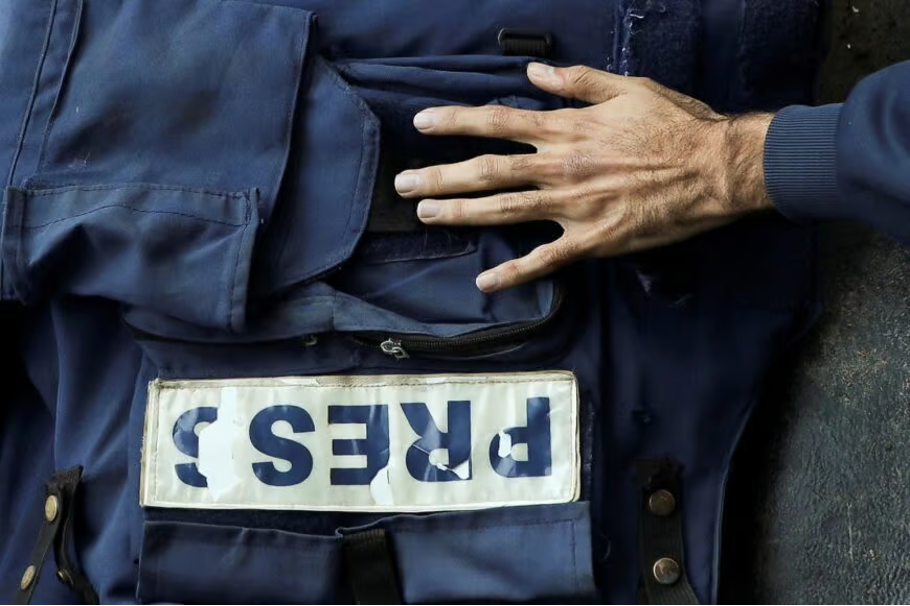
The conflict has struck Sudanese media with particular force. On the 18th of May 2025, photojournalist Al-Shykh Al-Samany Saadaldyn Mousa Abdulla, affectionately known as “Sheikho”, was killed in a drone strike. Sheikho is not the only one. Journalists and media workers have been killed while attempting to document events. Around ninety percent of the country’s media infrastructure has been damaged or destroyed. Roughly a thousand journalists have been displaced: “everyone was fleeing the inferno of flames”. Many left their newsrooms without knowing whether those institutions would ever operate again. In large parts of the country, independent radio has gone quiet, newspapers have halted publication, and local stations have been seized or closed. The result is an information vacuum in which rumour and crafted falsehood move more easily than verified fact. Communities that once depended on local media for safety information, humanitarian updates, and basic news are left without clear reference points; the dismantling of journalism becomes a dismantling of orientation.
This pattern is not a neutral by-product of conflict. It reflects the way those whose task is to make violence visible become targets. Since the war began, Sudanese journalists have been shot, abducted, beaten, pushed into exile. Records state at least fourteen journalists and media workers have been killed, with many more threatened, detained, tortured, or simply gone. Offices in Khartoum and other cities have been raided or converted into improvised detention sites. Internet blackouts have interrupted communication for millions, cutting the channels through which testimony travels and evidence circulates. A war that destroys lives is accompanied by a campaign that attacks the means by which those lives can be described.
Yet even in these conditions, reporting has not ceased. In early 2024, independent Sudanese outlets created the Sudan Media Forum to provide verified information and humanitarian guidance. With support from programmes devoted to press freedom and journalist safety, the Forum established a shared newsroom and coordinated coverage across participating organisations. It has issued practical updates on security, displacement and access to assistance, with particular attention to women in areas where violence has fractured ordinary networks of information. Reporters work from neighbouring states, temporary offices, private homes and unstable connections. Their persistence suggests that reporting, even when reduced to fragments, operates as a refusal of disappearance. Each dispatch asserts that what happens in Sudan belongs in the public record.
Within this landscape, journalism cannot be treated as simply technical craft. It is a practice of recognition. To report from a conflict is to affirm that events there form part of a shared history rather than remaining enclosed within local memory. Serious journalism treats each testimony as a claim against erasure, indicating those whose homes are destroyed or whose relatives vanish will not be reduced to statistics without contest. To record their names and words is to resist a political environment that would prefer them to remain abstract.
When journalists are suppressed, this function becomes a central object of pressure. The assault on reporters and media institutions in Sudan is, in practice, an assault on future accountability. If no one records which units entered a neighbourhood, which commanders ordered a bombardment, which forces controlled a road where people disappeared, later attempts to establish responsibility begin from a position of deficit. Control over information becomes a form of control over memory.
Communications blackouts deepen this effect. When authorities or armed groups shut down internet and mobile networks, they sever more than personal contact. They interrupt the flow of images, testimonies and data that might leave the country. Humanitarian agencies report periods in which Sudan has been plunged into near-total communication darkness, with aid operations unable to coordinate assistance and residents unable to document attacks. In such moments, those inside the country know what is occurring, yet struggle to transmit their accounts. Those outside suspect that extreme violence to be taking place, yet lack the concrete detail that turns suspicion into clear knowledge and gives political claims a stable foundation.
The consequences for how crises are prioritised is direct. Humanitarian systems depend on information, and political attention is shaped by what remains visible. Sudan’s war, despite its scale, competes for space with conflicts that enjoy more constant coverage or clearer narrative frames. Even when agencies warn of famine, mass displacement, and organised violence, those warnings have difficulty gaining traction in an environment where Sudan rarely occupies the centre for more than brief periods. Suffering that does not acquire a stable narrative presence becomes easier to postpone, easier to push toward the edges of public concern.
The erosion of journalistic freedom in Sudan therefore speaks to more than the fate of one profession. Any framework that claims to value human rights and humanitarian responsibility presupposes access to shared facts. If entire neighbourhoods can be destroyed without sustained documentation, if starvation and flight can expand without continuous public record, then claims to universality are weakened. Legal norms and humanitarian doctrines operate on the assumption that serious violations will be known in some form. When knowledge itself is obstructed, those norms risk becoming assurances that do not reach the events they are meant to constrain.
The freedom to report from conflict cannot be treated as a marginal question. The right to inform and to be informed is part of what makes any notion of shared responsibility plausible. Attacks on journalists in Sudan highlight how easily collective understanding can be shaped by those who control territory and weapons, how dependent public judgement has become on the survival of those who are armed by their notebooks and cameras in the face of war. When their work is obstructed, the field in which citizens and governments form their decisions contracts. Choices about aid, asylum, and diplomacy are then made within a narrowed horizon of knowledge.
The ethical stakes reach beyond those who hold press cards. The right to bear witness implies a readiness to receive what is witnessed. Those who work inside Sudan to document war, often without strong protective structures, act in the expectation that someone, somewhere, beyond their borders, will pay attention to what they record. Their work expresses a particular form of trust. It assumes that the testimony they risk their lives to gather will not simply disappear into archives or brief items that attract no sustained concern. To respond to that trust involves a public willingness to resist the fatigue that long conflicts produce.
Sudan’s war reveals how fragile this chain of witnessing can be, and also how persistent. Despite killings, threats, and exile, Sudanese journalists continue to report from the inside. Despite communication shutdowns, they use whatever connections remain to send images, testimonies and analyses to regional and international outlets. Despite the risk this poses on their lives, their reports, though fewer than the crisis warrants, prevent a complete blackout. Through their sacrifice, they ensure that the falling trees produce some sound in the wider world in this war on witness.
The question is not whether the war in Sudan exists. Its reality is ceaselessly felt in Sudanese homes, Sudanese streets, Sudanese lives. The question is whether the wider international world is prepared to live with a situation in which a war of this scale can remain largely unseen. To accept that outcome is to accept that the experiences of millions can be rendered opaque by the destruction of media offices and the shutting down of networks. It is to accept the lives of those who cannot reach the global public sphere will carry less weight than the lives of those whose suffering arrives with constant images.
The world’s attention is born in the newsroom. The erosion of journalistic freedom in Sudan is therefore more than a national crisis. It is one instance that tests whether the principle of witness retains substance in international life. If a tree falls and no one hears it, the loss remains real, but something has happened in the surrounding world that did not listen. In Sudan, the trees are falling in places that have names, in cities that once held newspapers and radio stations, in communities where journalists tried to speak before they were forced to stop. To defend their right to report, to respond to what they have recorded, is to insist that violence is never entitled to unfold unheard.
Image courtesy of Abd Elhkeem Khaled, © 2025. Some rights reserved.
The views and opinions expressed in this article are those of the author and do not necessarily reflect those of the wider St Andrews Foreign Affairs Review team.